

October 26th: Terror in the Aisles (1984)
Andrew J. Kuehn's Terror in the Aisles is a collection of clips from (mostly) horror movies. While this has becomes a sort of cottage industry now (Something Weird Samplers; Synapse's excellent 42nd Street Forever series) with the advent of DVD, there were plenty of themed trailer collections in the days of VHS as well. Often, these tapes are simply commercials for a distribution company's back catalog. Terror in the Aisles is neither a nostalgic gimmick nor a marketing strategy, Kuehn seems to really love film. The objective here isn't to sell you on lesser-known fright films, its to remind you why the ones you already know about are still relevant. This is the intent anyway. The films on display are the bright lights of the genre: The Thing, Carrie, Scanners, Jaws, An American Werewolf in London, Exorcist, and Chainsaw Massacre.
Oh yeah, and Halloween. Lots and lots of clips from Halloween. This may have something to do with one of the hosts of the anthology: Loomis himself. Donald Pleasence hosts Terror in the Aisles along with Nancy Allen as his counterpoint. Pleasence, basically playing Loomis, roams a dark theater, where a room full of actors respond to unseen images on the big screen. Allen appears mostly in voice only, but occasionally the roaming camera will find her in one of the rows. Despite Pleasence's typical theatrics, Allen's calm, controlled demeanor is the real commanding presence in the film. Pleasence is grim, cryptic, teacherly; Allen is more inviting, inclusive in her earnestness (she's clearly having a blast). The typical Pleasence line goes something like: "There's something delicious about fear," or: "Perhaps we invent artificial horrors to help us cope with the real ones." Not limited to these wrap-around scenes, Allen and Pleasence are heard throughout, often speaking over clips.
The clips are divided into thematic clusters. One for Hitchcock features archival interviews with Hitch, and is the only section to feature a filmmaker speaking on his or her work. One section weighs the merits of suspense building over sudden shocks (Alien is used, as well as Jaws). A bizarre section on villains introduces clips from films which aren't in the horror genre (Nighthawks?), including clips from Vice Squad featuring Wings Hauser. At this point Nancy Allen takes over to host the bulk of the final segments.
Allen introduces a segment on women in horror with "And, unfortunately, in these movies, the victim is almost always... a woman.", and later adds "We are all born... totally vulnerable... slowly but surely, we learn to be afraid. We're taught the difference between right and wrong... and yet we're only human." This is in sharp contrast to Pleasence's constant talk of "evil" and "the Devil". I can't say whether Kuehn intended for their to be a difference in viewpoint, but it sure seems that way. Kuehn introduced the segment this way in order to examine closely the genre, to criticise it if necessary. Alas, the message only seems to be that this is unfortunate for the female characters themselves, which is obvious. Allen: "What the one thing these films have in common? People in trouble! [extreme playfulness here] And what gets people in trouble? Sex!" This is a totally irrelevant and tasteless section serving only to get some tits into the film, including revealing shots of Allen herself in Dressed to Kill. Yet, Allen also recites, with a sincere critical tone, "In terror films, sex rarely ends in pleasure; it ends in violence." If Kuehn meant only to point to abusers on screen, Allen seems to question certain filmmaker's motives via the power of her delivery.
A short section on science fiction is also included. Pleasence: "Malevolent life forms from other planets may jeopardize our position as supreme beings on this planet." Clips from the Body Snatchers remake are then shown. At the end Pleasence comes back to talk about horror's evolution from the Famous Monsters to slashers, and a truly awful song, "They're not very nice," by Larry Weiss, plays over some recap clips. After this, an unhinged Pleasence sits in the vacated theater: "It's only a movie... it's only a movie... but sooner or later, you must leave the theater and go home, perhaps alone!" This is all great fun. The interstitial bits are actually the best part of the film. Light on insightful commentary, it's a bit of a bore to sit through too-long scenes from movies best viewed as a whole, even if they are occasionally edited together in interesting ways (example: dialog from Rosemary's Baby and The Omen spliced: "God help me!" "God is dead!"). If someone makes a comp clip of just these theater scenes, definitely watch it. In the meantime, just watch the films themselves.
(This is kind of a cop-out review. Gimme a break I was busy today.)
ABOUT THIS BLOG
Saturday, October 27, 2007

Thursday, October 25, 2007
The October Ordeal Day 25: Ghostwatch
October 25th: Ghostwatch (1992)
(Whole review is a big spoiler)
In 1992, Leslie Manning put together a live BBC expose concerning the paranormal. The special aired Halloween night, with English personality Michael Parkinson as host. While supplemental interviews with skeptics and believers alike are included, the special focused mainly on one particularly haunted house: the home of Pamela Early and her two daughters Suzanne and Kim. A camera crew had agreed to spend the entire night in the Early homestead, to see if a malevolent poltergeist young Kim has named "Pipes" will show his presence. In studio with Parkinson was paranormal investigator Dr. Lin Pascoe, and--via satellite feed--skeptic Alan Demescu. Operators stood by to answer phone calls from viewers. As the special progressed, it became apparent that something was indeed haunting the Early home, and was somehow affecting not only the studio crew but also viewers. A caller with some shocking information about the house set events in motion which cut through the stuffy BBC presentation to create uncontrollable chaos. By the end, it seemed all involved were in extreme psychic danger, and "Pipes" seemed an irrefutable reality. The rub: none of it was real. Besides the known television personalities, the characters in the film are played by actors.
I had the benefit of starting this film believing it was in fact a documentary; while I figured out it was a hoax less than fifteen minutes in, I can imagine many viewing the film wouldn't catch on, especially children. Indeed, Ghostwatch supposedly makes the British Medical Journal as the first television show to have caused Post-Traumatic Stress in young viewers. If you read the IMDb message boards, it becomes obvious that this film had a major impact in the UK when it first aired, and that many believed it the entire way through. Parkinson and the other British reporters in Ghostwatch are all household names in the UK, which lent the film a special believability.
The opening scene in the film is a bit of archival footage from the Early girls' bedroom. This sequence is the film's most frightening. For several minutes the audience is forced to scan a pitch-black room, which remains distressingly still, until eventually the girls begin to scream, as the room shakes its contents until a lamp crashes to the ground. At this point I began to suspect I was being had. Watching the shape of the film solidify, this fact becomes rather obvious. The editing is too tight to be live, and some of the actors give it away, especially mother Early. All of the newscasters, however, are fully believable. After all, these are professional fakers. Also by the end, subtle musical cues are audible. The filmmakers perhaps thought viewers would be too terrified to notice.
Pipes, while never the subject of a filmic reveal, is hidden throughout, flattened in dark crevices of the frame. Many viewers have attempted to make lists of his many appearances. Pipes is even supposedly standing in the crowd of rubberneckers gathered outside the Early home. I must admit, I didn't see him once, and I was looking too. I'll definitely be revisiting the picture with this in mind.
While the reality of the film might have been better handled (style would need to be sacrificed), this is still incredibly bold, riveting television. A DVD is available from bfi which contains an informative commentary track. Ghostwatch, after all, is more than TV, its a historical event. While on this side of the ocean it may not be as effective, and time is not on its side, this is still a tight, brave, and yes, scary film.
Wednesday, October 24, 2007
The October Ordeal Day 24: Warning Sign
October 24th: Warning Sign (1985)

Warning Sign begins with an old-fashioned establishing main titles-montage. In a procedural sequence, we meet our Hazmat-suit clad subjects, average-looking scientists occupied with mundane yet dangerous work: the sequencing of airborne bio-chemical weapons. In a rather Spielbergian manner, a series of random events result in the infection of the team, which they unknowingly carry to the rest of the industrial plant where they work (Director Hal Barwood actually worked under Spielberg on Close Encounters). A stray test tube, a piece of electrical tape and a Polaroid camera all play their part. As a result of this random—yet totally logical—mistake, the film is absent any specific villains; accidents can happen. While the virus—synthesized by living breathing humans—is a serious threat, it is a blind, uncaring nemesis, motivated not by anything like human emotion.
Noting early the contamination, chief of security Joanie Morse (Kathleen Quinlan, perfectly cast) follows her own pre-scripted procedure and initiates the plant’s contamination protocols, shutting the plant down and sealing its workers inside. Lockdown. The agitation the workers feel is compounded by the fact that it’s mere minutes before closing time. While there are plenty of upset people inside, there are just as many gathered outside, unable to reach their quarantined family members. While Joanie Morse is in-charge inside the plant, maintaining order outside of it is the task of her husband, Sheriff Cal Morse (Sam Waterston, another fine choice).
Arriving almost instantaneously is the “U.S. Accident Containment Team,” led by Yaphet Kotto as the deliberately hard to read Major Connelly. “USACT” lies to the community (and gathering media), claiming an experimental yeast has been loosed in the lab, and may damage area crops if allowed to escape. Turns out no one in town (somewhere in Utah) actually knows what really goes on inside the walls of this typically banal industrial building. For—what I assume to be—narrative reasons, Connelly is honest with Sheriff Morse, describing genetic engineering as a “new technology,” with “certain risks.” While Warning Sign may ultimately be an apolitical film with a topical source of dramatic material, Sheriff Morse is a germaphobe skeptic cast as Connelly’s counterpoint. Connelly sees chemical warfare as the appropriate response to a perceived arms-race. “Deterrence in kind” he reasons.
While Morse’s intellectual argument with Connelly on the outside may be mere banter, if there is any argument made against chemical weaponry it is articulated inside the sealed compound. The scientists first infected (including G.W. Bailey in a dramatic role) pass out from fatigue, only to awaken agitated and irrational. While still capable of reason, they are gripped by an uncontrollable “rage” (shorthand for the effects of the virus) which eventually crosses over into remorseless savagery. As the infected become murderous, the film turns sharply to horror, whereas prior to this point it has more in common with politically-motivated thrillers such as The Andromeda Strain and The China Syndrome. Since the film has been watertight and provocative thus far, the audience is willing to follow the film into horror territory. Connelly explains that the virus is “…designed for tactical confusion”; the effects seem manageable at first, but steady escalate.
Escalation is central to Warning Sign. A level of intensity is difficult to maintain in any film, let alone to control. Remarkable then, that a film with such a low budget manages to ramp up so expertly action, tension, conflict, and audience excitement.
At this point in the film knowledge becomes a fractured force. Those on the inside need information about action outside, and those outside not only need to know the inside status, but maintain order among the increasingly agitated community members by feeding them disinformation. While Warning Sign is a serious—almost grave—film, two bits of comic relief are allowed: the few workers who made it out before the doors sealed are forced to walk around in bubble-boy type apparatus, and are the obsession of the sensationalist media; and while the plant is becoming a living hell for the other quadrants, one group of scientists and laborers hole up in a break room playing Atari and eating snacks, largely ignorant as to what’s going on outside the locked door. As a kind gesture, these characters actually manage to survive.
(Spoilers ahead—watch out!)
After losing radio contact with Joanie, Sheriff Morse decides to break into the facility. With the help of a former employee, Dan Fairchild (Jeffrey DeMunn, an actor with an incredibly expressive face), Morse enters in through an air-intake at the back. While it is slightly far-fetched, an acceptable Deus Ex-Machina allows The Morses and Fairchild to synthesize an anti-virus, which they use to save many of the infected. In an often fatalistic genre, its interesting to see such a roundly optimistic ending. By the film’s end, all zones of the facility are completely clear. At least, “for a while” as Fairchild says, making for at least a bittersweet conclusion. Sheriff Morse replies “Worry about it tomorrow.” As a “Hollywood” ending, its somewhat cheap, but still a fitting end to a highly successful formalist thriller. Warning Sign proves that despite a micro-budget, a trio of great character actors and an accomplished sense of mood and pacing can be all the necessary ingredients in the recipe for a fine film.
(The Anchor Bay DVD looks great by the way)
Tuesday, October 23, 2007
The October Ordeal Day 23: Lifespan
October 23rd: Lifespan (1974)
Elysian Fields released in May of this year a pair of lost Terry Riley soundtracks on one disc, songs composed by Riley for both Joel Santoni’s 1972 film Les Yeux Fermes and Alexander Whitlaw’s Lifespan. This bit of excavation put me on the lookout for both films, and only days after learning of Riley’s film collaborations, Lifespan appeared to me during my last visit to the now on-hiatus Astro Video. However, it became clear almost immediately that Riley’s music operates in the film as a phantom, an empty substance. Riley’s music here is barely noticeable: it’s chopped up, lost under dialog and low in the mix, present for no more than 30 seconds at any time. While an Erik Satie piece is also used, Riley’s contribution is slight, with original pieces but also a repeating snip from Riley’s “Poppy Nogood and the Phantom Band,” the companion piece to Riley’s landmark “A Rainbow in Curved Air.” While Whitelaw may have good taste, he has wasted the contribution of a true master, the genius of minimalism who is now over 70.
The story: American doctor Ben Land is determined to find the genetic fountain of youth, to develop a serum to “cure” death, which Land terms “a disease.” While Land may claim altruistic motives, he himself is terrified of dying. As one of his colleagues points out, its odd such a young doctor has chosen to devote his life to the eradication of natural death. Land is called in Lifespan’s early moments to Amsterdam, to dialog with the world’s leader in the field, Dr. Linden (Eric Schneider). Before Land can meet with Linden, he is found dead in his apartment, an apparent suicide. Land agrees to continue Linden’s work, and is assigned a personal assistant in grad student Pim (Frans Mulder), the nephew of Linden’s friend Professor Van Arp (Fons Rademakers). In what appears to Land to be a serendipitous encounter, he also meets Linden’s mistress Anna (Tina Aumont, delivering one of the film’s best performances), whom he stalks around Amsterdam after he is blatantly used by Anna to satisfy her kinky sexual desires. Anna is somehow involved with a mystery man from Switzerland, the enigmatic millionaire Nicholas Ulrich (Klaus Kinski, who manages to infuse this stock character with depth and nuance).
The major reason there is no room for Riley’s music to breathe is that it becomes muted by an incessant and unnecessary narration. While the film is Dutch, the protagonist, Dr. Ben Land (American actor Hiram Keller) is an American, and his dialog and narration do not appear to be a feature only of the English-language release. Lifespan’s unending voice-over nearly sinks the film; Land’s narration recounts the events of every scene and outlines the film’s obvious themes. Every scene transition is smeared with this unwelcome insurance. Lifespan is a lesson in how first-person narration can become a heavy blunt object, smashing the film’s integrity as it barges blindly forth.
The narration may be a late addition to the final cut, an attempt to flesh out a main character, who should have allowed to simply be a cipher. Ben Land is a shallow character, driven by his obsessive nature. Keller is a dull leading man, an actor playing it cool but obviously clueless. This would be an example of mindful casting if the narration were removed; throughout Lifespan Land is positioned as a powerless pawn in a game larger than himself. The empty vessel of Ben Land eventually becomes Linden, as Land finds himself inhabiting Linden’s life, examining his notes, inheriting his position at the university, dating his girlfriend, and living in his apartment. Since his ambition was also Linden’s, his fall is orchestrated in a similar manner and Kinski is there to recruit the technician he needs to give his mad scientist dreams shape and structure.
What Ben calls “the horrors of the aging process” are being experienced by Ulrich, who realizes immortality is within his reach as long as he acts. Ulrich and his disciples Land and Linden represent the arrogance of science without ethics or reflection, and while Ulrich may be a more cautious Deadalus, Icarus is played by both Linden and Land, younger seekers flying too close to the sun.
While Lifespan squanders its score, the cinematography is of a specific and well-conveyed mood. Black and white are used to represent life and death, and whomever is in search of immortality (or whomever has found it) surrounds themselves with white; in many scenes, sheets of white linen hang inexplicably. From the white walls of the psychiatric hospital, to the long-lived mice to the reverently photographed Swiss Alps of Kinski’s Fortress of Solitude.
Late into the film, what seems like a traditional narrative essentially crumbles. Ulrich and Anna reveal to Land that Linden was studying the secret notes of a Russian scientist named Rashinski, who discovered the genetic secret to immortality before his death. This revelation breaks into the film uninvited; it is convenient, yet brings the film into a hallucinatory and bendable place. All story up to this fracture is cast into doubt as the crust of a massive conspiracy is exposed. An old man granted immortality by Linden has died, Pim has sold Land out to his uncle, lab notes concerning Linden’s immortal test mice have been doctored and Land is committed to a psych-ward for digging up the dead. This may be the proof of a campus-wide cover-up, it may also be Land’s delusion. Land is a fool no matter the case, led along by all parties, blind in his single-mindedness.
Land breaks from the University and Van Arp to join Kinski in Switzerland as his Igor. After the film’s only piece of inspired narration, Lifespan abruptly ends on a note of appropriate ambiguity. This conclusion is highly satisfying and even the film’s flawed elements crystallize into a cohesive and cooperative whole. While editing could have made Lifespan a classic, it is nevertheless a dreamlike, hallucinatory film about the collective mad quest for immortality.
The October Ordeal Day 22: Fangoria's Weekend of Horrors
October 22nd: Fangoria’s Weekend of Horrors (1986)
 From the beginning of The October Ordeal I intended to review Fangoria's Weekend of Horrors at some point. This is one of my all-time great Astro Video finds. As you can see, it features a fine painted cover, complete with the two greats of slasher cinema, Freddy, and... Troll? This perplexing coupling indicates the schizophrenic nature of this one hour documentary (if it can be called that), which appeals to the lowest common denominator yet also yearns for legitimacy and respectability for the horror genre. This is why a typical (and unacknowledged) irony underlines the entire film (film?). Example: Robert Englund sincerely relates, "They're very intelligent... [the] fans" after we've seen a montage of fan chatter where a mustachioed stoner enthuses "Some movies have tasteless blood and guts… and the other ones where you see girls getting hacked up in bed… those are OK." What the hell? Moments later a kid who must be ten gushes “I like the blood coming out of the eyes, the mouth.”
These days, the convention circuit is of course a really big deal. Cable television channels report from the floors of Comicon and E3, which have both in many ways become live commercials for Hollywood properties. This is all supposedly in the name of "giving back" to the fan community, but this is rather transparent in its falsity. Comicon especially seems merely a cheap way to generate buzz, particularly the Internet-based kind. It's interesting here to see a con the old fashioned way. It's 1986, and there are no PR suits anywhere in sight.
While I doubt the fans in 1986 would approve of the corporatisation of the con, because of their perceived marginalization, the filmmakers here (including Fango editor-in-chief Kerry O'Quinn) seem above all committed to proving that horror fans are regular folks. While the mullets and stone-washed jeans are quite frightening, I doubt most people hold real prejudice against horror fans. Just to prove these people aren't dope fiends or gutter-punks, the filmmakers ask every attendee interviewed what they do for a living and--can you believe it--it turns out they have normal jobs like everyone else. They even have families and live in houses! Who knew?
That said, the fans do seem overwhelmingly nerdy, the vendors especially. They are asked to explain how they got into the business, and most relate the rather boring (and sometimes sad) stories of their lives. But there is something genuine about these gore-hounds; I'll take these denim-clad stoners any day over smug guys with Eli Roth haircuts who smell like Axe body-spray.
While an overwhelming percentage of the running length is spent with the fans, a fair amount of time goes to creator interviews as well. Englund's articulate, erudite, almost fey presence is by contrast quite interesting. He and Craven both have a lot to say about the horror genre, and elucidate certain concepts and theories in ways no fan present seems to be able to. Craven's riff on "rubber reality" (he compares the first Nightmare to Cocteau) is particularly good. Dan O’Bannon gets in-depth, positing the universal fear of death as the beginning of all art. Not all the guests are so serious, and its great to see Elvira, Dick Miller and Clu Gallager just having a good time. Effects-men are particularly idolized (this is Fangoria), and Rick Baker, Stan Winston and Tom Savini are given plenty of face-time.
While the on-the-floor stuff is fantastic, the center of the film collapses into a black hole of boring fan-films, culled from Fango's annual short film competition. As far as the technical aspect, while I'm sure that documentation by any means was the goal, the image and sound are fine, from what I can tell. I say this because the tape is completely degraded and fucked-up. Waves of rolling fuzz began to engulf the VHS at about the ten minute mark and never let up. The sound eventually became a garbled crunch and my VCR began to literally wince in pain, emitting a high-pitched squeal. Its a miracle I made it all the way to the end. Better retire this Media tape to the cabinet.
Despite a terrible Casio score, overlong clips from Nightmare and Return of the Living Dead, the dreadful fan-film showcase and its incredibly scarcity, this film--which is essentially a promo item--is a prime pic for a Halloween party; its a time capsule sure to please any horror crowd. And don't worry about exploitation, the filmmakers themselves are totally geeked-out and enthusiastic. Enthusiasm seems to be the theme of the piece, coupled with a plea for mainstream acceptance. Unfortunately, if these hardcore gore-heads could see where "fandom" would go in the future, they might choose to retreat back into their solitary dungeons (and dragons).
Sunday, October 21, 2007
The October Ordeal Day 21: Body Bags
October 21st: Body Bags (1993)
Like the Romero/Argento effort Two Evil Eyes, Body Bags is an early 90s horror anthology largely forgotten by genre fans. John Carpenter directs the first two segments ("The Gas Station", "Hair"), while Tobe Hooper takes care of the final section, "Eye." Body Bags was originally conceived as a Showtime original series. When the network bailed, a longer edit of the pilot was released as Body Bags the feature film. More than ten years later, Showtime gave the fright anthology a chance with Mick Garris' Masters of Horror/Fear Itself series, which failed to live up to its potential in three seasons.
Carpenter is featured here also as an actor, playing a kind of zombie coroner who introduces each segment. In these brief wrap-around moments, Carpenter lazily plays the Crypt-keeperesque "Coroner" while Tom Arnold and Hooper appear as assistants. The gags in these scenes fall flat; it's hard to imagine this set-up working in an ongoing television series.
The look of Body Bags is similar to every workmanlike, homogenized Stephen King television adaptation or Sci-Fi channel original movie. I have nothing against this stock style; actually there's something nostalgic and disorienting about the look of this type of television. The uniform and dressed-down sets and camera set-ups wouldn't be out of place in a sitcom or Lifetime movie, and perhaps that's why this style is inexplicably frightening in its seeming displacement.
This lends a lonely, depopulated feel to the segments, particularly the first, "The Gas Station." College student Anne (Alex Datcher) faces a serial killer while working her first-ever shift at an all-night pay-and-pump. While accomplished in mood and pacing, this segment suffers from a poor performance by Datcher and a distracting series of cameos. In a row Wes Craven, Sam Raimi and Carpenter favorite "Buck" Flower drop by. The entire film is full of cameos, in fact, from Arnold to Roger Corman to Debbie Harry and beyond. While the comedic second half benefits from its crowd-pleasing cameos, here they serve only to take the audience out of a segment which relies on the immersive rhythm of a taut thriller narrative.
Stacy Keach chews it up as Richard Coberts in "Hair", the film's best section. Coberts is a balding man who'll do anything to grow his hair back, equating his receding hair with receding vitality. Coberts, desperate to gain his self-confidence back, signs up for an experimental program in which intelligent hair follicle-monsters are grafted onto his scalp. In what plays like an adult version of The Peanut Butter Solution, Coberts wakes up the next morning with a ridiculously long, flowing mane of Fabio hair. The hair won't stop growing, and the killer micro-organisms seem to be eating him alive. While gruesome, "Hair" takes full advantage of its comic premise. Many of the jokes are laugh-out-loud funny. By allowing the segment to play for laughs at the expense of scares, Carpenter makes the film's smartest decision.
In the section which is the closest to the EC Comics/Creepshow aesthetic, Hooper directs "Eye" as a gory shocker, only subtracting the black comedy altogether. "Eye" is the weakest of the three segments, especially due to Mark Hamill's typically awful performance as Brent Matthews, a rising major league baseball star who loses his right eye in an auto accident. You guessed it-- the eye is cursed, transplanted from the dead body of a serial murderer (Ala yesterday's flick Body Parts). Hamill is just terrible, and sports a gnarly 'stache I found difficult to look at. Twiggy plays his wife. Weird.
While Body Bags may have been something of a throwaway gig for many involved, it actually remains interesting, despite the obvious and dated elements. I much prefer Body Bags to Masters of Horror, honestly. Who doesn't dig a good anthology film? While this may not be a classic, at least Carpenter's contributions are fully worthwhile. With Halloween fast approaching, now would be the best time to check this one out.
The October Ordeal Day 20: Body Parts
October 20th: Body Parts (1991)
(This is the final cop-out, I swear. Here's an old review. It isn't very well written. I'm running out of reserves, so this should be the last time I'll have to mine old SD material. There was simply too much going on today for me to watch a flick)
Body Parts is directed by Eric Red (writer of The Hitcher and Near Dark, and also potential murderer- Google it), and stars Jeff Fahey as Bill Chrushank, a psychology professor who loses his arm in a freak accident. As part of a new experimental program supervised by Dr. Agatha Webb (Lindsay Duncan), he receives a new arm, cut from a recently deceased serial killer (naturally). It takes Bill a while to get used to his newly grafted-on arm, especially since it seems to have retained some homicidal tendencies!
After alienating his family and freaking out his students, Bill decides to do a little P.I. work and figure out what’s up. He manages to find the names and addresses of the other participants, including unstable artist Remo Lacey (played by Brad Dourif!), who received the other arm and is now famous for his gruesome paintings, which are actually the killer’s murderous visions. He also locates the legs, which went to basketball player Mark Draper (Peter Murnik), an all-around nice guy who now runs incredibly fast, and hilariously drop-kicks people left and right. When Bill finds him, he’s just narrowly avoided crashing his car, when his foot slams unexpectedly on the gas at an intersection.
The three go to a bar to hash things out, but are so messed up from the killer parts they instigate a massive bar-brawl, fighting the patrons and each other. But things get even worse, when the killer returns- his head on a new body- and starts killing our protagonists to get his limbs back.
From then on the twists and turns never stop, with questionable science, schizoid performances, flying dropkicks, amazing basketball skills, evil doctors, suspicious cops, and Fahey shooting a gun at living body parts, suspended in a holding tank.
The film’s most inventive scene comes towards the end, when the resurrected killer (whom we learn is Dr. Webb’s son) pulls up alongside a police cruiser which Bill is sitting shotgun in, handcuffs Bill’s hand to his own, and speeds off, while the Jamaican cop in the driver's seat has no choice but to follow! Body Parts is one of the most inventive and enjoyable horror flicks I’ve seen in a while, thanks to real-life madman Eric Red.
Saturday, October 20, 2007
The October Ordeal Day 19: Mumsy, Nanny, Sonny and Girly
October 19th: Mumsy, Nanny, Sonny and Girly (1969)
While the décor of Mumsy, Nanny, Sonny and Girly (simply Girly in the States) is unmistakably upper-class, it makes no attempt to be anything other than trashy English sleaze. I can dig on sleaze. While being sleazy in an obvious manner, MNSaG is also surprisingly cruel and sadistic a film, delighting in its own transgressions.
The film’s title names the four surviving members of an old-money clan, essentially closed off from the outside world. Mumsy (Ursula Howells) and Nanny (Par Heywood) don’t seem to leave the estate, and have created a sick game to occupy their days. Siblings Sonny (Howard Trevor) and Girly (why didn’t Vanessa Howard’s career take off?) venture into town and round up drunks and club-hoppers, bringing them back to the house where they are drugged and imprisoned. The family subject their “new friends” to strange and complex games involving obscure rules and rituals. If a “friend” breaks too many rules—or becomes tiresome—they are chopped up and buried.
While we meet several unlucky drifters, in order to explain the family’s ongoing game, the only “friend” we spend any time with is Michael Bryant, playing “New Friend #2.” Bryant is a sort of non-entity in the film even though he’s given an excess of screen-time. He smartly realizes that he’s dead if he doesn’t play the game at least for a while. As he grows accustomed to the family dynamic, he discovers ways to upset the balance of power, turning Nanny against the family matron Mumsy, and Sonny against his sister--the object of his repressed desire--Girly. Bryant as New Friend #2 goes about bedding the women of the clan one by one—even ancient Nanny. These scenes aren’t played for titillation. In fact, there isn’t any nudity in the film. He simply sees several lonely women behind their whimsical/malevolent front, and takes an opportunity which he also finds pleasurable and natural, being a hip socialite. These scenes are played believably, and create the domino effect that may topped the house and allow “New Friend #2” to escape.
While Bryant may play the supposed antagonist, Howard and Trevor are the real life of the film—their dialog is a maze of snappy routines, children’s rhymes, extended riffs and spontaneous song. Its all very English, and very theatrical. No surprise then, MNSaG is based on a play. While over-the-top acting can kill the mood integral to this type of picture, here it really works. The structure of the film also points towards theater. The usual art of a typical horror film is nowhere to be seen. We spend almost the entire film with the villains, yet are never asked to like them.
The reason theatrical acting is appropriate is that the attitude of these characters is studied affect—they’re faking it. Being precious is part of the family put-on: they pretend to be a terribly average old-fashioned family as a sort of sick joke. Girly, for instance, has clearly been instructed to play the Lolita role, complete with short, short skirts and piles of porcelain dolls in her bedroom. When New Friend #2 seduces her, she reveals she is a virgin; this is the only scene in the entire film where one of the family lets their guard down. Whether or not this signifies anything is anyone’s guess. In a sense New Friend #2 is taking advantage of her the same way she has taken advantage of him. Every move in this film can be considered part of a grand strategy. There may be no lesson to learn here at all. New Friend #2 may play the game better than the makers of the rules themselves, but I’m not sure if any knowledge is gained from this observation. At no moment did I sympathize with his (intentionally) empty, playboy character. The film desires not to impart anything other than cheap thrills and a superficially cruel good time. Yet, there is a strange substance in its commitment and boldness.
Director Freddie Francis has had an interesting career. He began his directing career with Sci-Fi Horror film Day of the Triffids, then directed large handfuls of 60s and 70s English fright films, authored many an anthology-show segment, and topped off his career as David Lynch’s frequent D.P. After seeing this truly twisted piece of Euro-trash cinema, I’m quite interested in this era of his diverse career. Love the jazzy-psych soundtrack as well. While I have good things overall to say about this film, I doubt I’ll ever revisit it. So here it is, the classic cop-out in the face of indecision: this one is recommended for genre fans only.
Friday, October 19, 2007
The October Ordeal Day 18: Scarecrows
October 18th: Scarecrows (1988)
Every now and again I'll read about a film and think to myself "Why the hell haven't I heard of this?", especially if the film is of a genre and era I have some familiarity with. While Scarecrows is a very minor cult classic, I'm convinced that if the film had a name or two it would be a much better known horror picture. It certainly is deserving: Scarecrows is really quite good.
Scarecrows takes place over the course of a single night. The premise is simple: a group of ex-military theft a big bag of cash from the Army and escape with a hijacked plane and two hostages. A guy named Bert decides not to share the money and jumps from the plane over an old farm house. The gang land the craft and make chase, only to find an abandoned old farm and some seriously creepy scarecrows staked next to a family graveyard. The folks who used to run the farm--the Fowlers--seem to have migrated from the grave to the rotting scarecrows, and aren't too happy about being invaded. This is what we know, the rest is unexplained.
Thus Scarecrows is extremely short, barely 80 minutes in length. There is no central character, instead an ensemble cast, the actors of mixed ability. While there is barely any back story, there is a lot of set-up. The scarecrows don't even move until about 50 minutes in. While this may be a sure sign of a limited budget, it actually creates a real mood of fear. Each time the camera closes in on a scarecrow, The audience wonder if this will finally be the scene in which one comes to life.
Besides being legitimately frightening, the film gracefully maintains a bleak and moody atmosphere. And while there is some obvious day-for-night shooting, the darkness surrounding the action is quite effective. Interestingly there is almost a total lack of music in Scarecrows; often the airplane's radio or the group's walkie-talkies will stand in for a score. The film looks great, and the camera work is admirable. In most scenes the camera is constantly in motion, panning around, shooting through windows, suggesting the point-of-view of an unwanted prowler.
The film is also admirable for the mistakes it doesn't make. The cast is kept to a minimum, the running length is just right, there is no cumbersome and unnecessary back story, there is no stock nudity, there's no excessive gore, there's no romance, and--thankfully--there is no twist ending. The ending, in fact is great. While a NotLD style stand-off seems inevitable, the film actually takes the climax out of the Fowler's home and through the woods into the getaway plane.
One reason I'm surprised this film isn't better known is that it seems very much of its time. Like Pumpkinhead, this is essentially a morality play. While the thieves become likable as the film progresses, they ultimately must pay for their actions (they have in fact killed many Policemen since the robbery). This aspect also lends the film the quality of a good anthology segment, perhaps as a choice episode of Night Gallery. If I've made my points rather quickly, its because this is a brief, breezy film. No masterpiece, yet fully accomplished. If you have an empty slot on your Halloween-night marathon list, add this one. Your friends will all ask, "How come I haven't heard of this?"
Thursday, October 18, 2007
The October Ordeal Day 17: Race with the Devil
October 17th: Race with the Devil (1975)
Jack Starrett's Race with the Devil is a trim, confident road-thriller. RwtD simmers for the first two thirds (the way good thrillers often do), establishing rhythm between characters and creating tension, simply by not alluding to any terror to come. This provides necessary context for an extended series of scares in the final act (think Texas Chainsaw Massacre). This model may be named "endurance cinema": the payoff is going to be big, going to be great, only patience is required. And the payoff in this film is fantastic; Race with the Devil really cooks in the final third.
Peter Fonda and Warren Oates star as two old friends on a skiing trip with their wives in a brand new RV, whom stop over in a small Midwestern (I presume) town for some shut eye. Putting a few beers away outside the RV, Roger (Fonda) and Frank (Oates) notice something a bit strange just over the hill. It seems a black magic ceremony is underway, robes and all. Frank and Roger have a great time checking the action out with binoculars, until things get ugly: it seems a human sacrifice is needed to complete the ritual. From here the Satanists pursue the men across the film, on and off the road.
While Starrett claims he cast real Satanists for this early scene, the film is not concerned with the supernatural. Its not really even about the practice of Satanism. We never see these specific people again; there is no villain, there is no mastermind. The threat in the film comes in the form of the automobile, as anonymous trucks pursue the RV Ala Duel.
Oates and Fonda play the only real characters in the film. Loretta Swit and Lara Parker play their wives, yet are completely decorative in function. While many chase movies mythologize the male speedster at the expense of any strong female characters, Race with the Devil is really remarkable in its blatant sexism. The wives here are constantly weeping, and utterly unable to defend themselves or even think rationally in the face of any obstacle. Wives Alice and Kelly are in constant need of consoling from their heroic husbands, and only require that they assert themselves, rather than include them in any strategising or defensive action. In this capacity women are presented merely as cinematic trope, as necessary props.
In fact, male assertion is the theme of the film. In one scene, Fonda stands reluctant with a shotgun before a Satanist climbing through the RV's rear window. Oates, driving, barks, "Do it!" and Fonda fires. The idea, I suppose, is that post-hippie city-boys must regain their manhood via a test, a quest through the unknown wilds of uncivilised America. It always struck me as odd in films like Deliverance that the "city-folk" presented acted pretty much exactly like the hicks they faced off against (except with better teeth, of course).
Alas, this stuff comes with the territory. I'm willing to overlook this particular nastiness out of respect for the excellently choreographed final chase. This sequence is plainly the film's raison d'etre, and it must have been great on the big screen. While the "gotcha!" final reveal I saw coming a country mile away, I was left quite satisfied by this well-dressed, expertly-paced bit of genre filmmaking. Liked Death Proof? Give this one a queue.
Wednesday, October 17, 2007
The October Ordeal Day 16: Black Roses
October 16th: Black Roses (1988)

The micro-genre of “metal horror” is made even smaller considering that its two best examples are directed by the same guy. John Fasano struck b-movie gold with Rock and Roll Nightmare, a perfect example of the “so bad its good” genus. The fact that Black Roses is of a considerably higher budget actually creates a new challenge for Fasano; Rock and Roll Nightmare is a blast partly because its so unbelievably cheap (that and the fact that it stars metal-warrior Jon Mikl-Thor). Black Roses does not immediately signify “B” the same way RNRN does from its first frames. Its harder to like, in other words.
The plot of RaRN is strategically confined to one central shooting location and a half-dozen characters. In contrast, Black Roses’ narrative arc involves an entire town, lending what is practically an ensemble cast. The story in Black Roses is something Stephen King could have dreamt up: an upcoming metal band (the Black Roses) book several shows in a small town (somewhere in Canada, from the look of things) to test out new material before launching a national tour, much to the dismay of the town’s adults. Their kids, of course, are thrilled, and Black Roses-mania sweeps through the high school. John Martin plays Mr. Moorhouse, a progressive English teacher who notes a change in his students as soon as the Black Roses flyers start showing up all over town. The Roses’ glam-metal stylings turn out to be so bitchingly bad-ass that they cause average kids to turn into gothed-out murderers. It’s up to Mr. Moorhouse to put an end to the Roses, who may or may not feature Satan himself as lead singer.
Concerns over the PMRC by guys with goatees is a pretty widespread (and rather uncontroversial) cause in art from the 80s and 90s. From Twisted Sister to G’n’R, the impression is that butt-rock and hair-metal are the final warriors in an epic battle in the name of free speech. Figures like Tipper Gore and Joe Lieberman hardly make dynamic villains, so in films like Black Roses demons and killer stereo speakers stand in. This makes for some silly self-mythologizing on the part of metallers and their sympathizers; the idea that drug-fiend womanizers are really standing up for anything is a strange one indeed. However, I do dig the tunes, and like RaRN, the score here offers some stoopid thrills at every turn.
Besides a presentation of the Fear of a Metal Planet, this film offers plenty of cheap-thrill effects scenes, a monumental improvement upon the sock-puppet monsters of Fasano’s previous metal masterwork. The performances are pretty bad, but this only adds to the charm. The personalities are stock, and that’s fine by me. The film visually is interesting, with a large amount of camera variation, from shaky hand-held to neighborhood-surveilling crane shots. Fasano has gone on to direct high-profile television since, but some scenes here point to music-video potential. The concert scenes in both this film and RaRN stand alone as dynamic sequences. I imagine the coveted VHS copies floating around out there look grainy and faded, the recent Synapse DVD looks fantastic.
Aside from its obvious flaws, Black Roses is a fun, fast-moving film. The politics aren’t heavy-handed, and underpin the story in a natural way that allows for Black Roses to exist first and foremost as an old-fashioned gothic horror film. A cheesy gothic horror-film, yes, but a highly enjoyable one at that. While my fellows at Samurai Dreams are divided on this film (Andy digs is considerably more than I; Kevin, Max and James loathe it), I can recommend it with clear conscience. Just don’t get your hopes up for a Thor cameo.
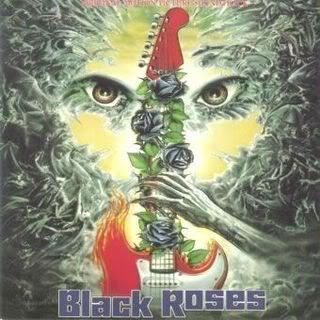
The micro-genre of “metal horror” is made even smaller considering that its two best examples are directed by the same guy. John Fasano struck b-movie gold with Rock and Roll Nightmare, a perfect example of the “so bad its good” genus. The fact that Black Roses is of a considerably higher budget actually creates a new challenge for Fasano; Rock and Roll Nightmare is a blast partly because its so unbelievably cheap (that and the fact that it stars metal-warrior Jon Mikl-Thor). Black Roses does not immediately signify “B” the same way RNRN does from its first frames. Its harder to like, in other words.
The plot of RaRN is strategically confined to one central shooting location and a half-dozen characters. In contrast, Black Roses’ narrative arc involves an entire town, lending what is practically an ensemble cast. The story in Black Roses is something Stephen King could have dreamt up: an upcoming metal band (the Black Roses) book several shows in a small town (somewhere in Canada, from the look of things) to test out new material before launching a national tour, much to the dismay of the town’s adults. Their kids, of course, are thrilled, and Black Roses-mania sweeps through the high school. John Martin plays Mr. Moorhouse, a progressive English teacher who notes a change in his students as soon as the Black Roses flyers start showing up all over town. The Roses’ glam-metal stylings turn out to be so bitchingly bad-ass that they cause average kids to turn into gothed-out murderers. It’s up to Mr. Moorhouse to put an end to the Roses, who may or may not feature Satan himself as lead singer.
Concerns over the PMRC by guys with goatees is a pretty widespread (and rather uncontroversial) cause in art from the 80s and 90s. From Twisted Sister to G’n’R, the impression is that butt-rock and hair-metal are the final warriors in an epic battle in the name of free speech. Figures like Tipper Gore and Joe Lieberman hardly make dynamic villains, so in films like Black Roses demons and killer stereo speakers stand in. This makes for some silly self-mythologizing on the part of metallers and their sympathizers; the idea that drug-fiend womanizers are really standing up for anything is a strange one indeed. However, I do dig the tunes, and like RaRN, the score here offers some stoopid thrills at every turn.
Besides a presentation of the Fear of a Metal Planet, this film offers plenty of cheap-thrill effects scenes, a monumental improvement upon the sock-puppet monsters of Fasano’s previous metal masterwork. The performances are pretty bad, but this only adds to the charm. The personalities are stock, and that’s fine by me. The film visually is interesting, with a large amount of camera variation, from shaky hand-held to neighborhood-surveilling crane shots. Fasano has gone on to direct high-profile television since, but some scenes here point to music-video potential. The concert scenes in both this film and RaRN stand alone as dynamic sequences. I imagine the coveted VHS copies floating around out there look grainy and faded, the recent Synapse DVD looks fantastic.
Aside from its obvious flaws, Black Roses is a fun, fast-moving film. The politics aren’t heavy-handed, and underpin the story in a natural way that allows for Black Roses to exist first and foremost as an old-fashioned gothic horror film. A cheesy gothic horror-film, yes, but a highly enjoyable one at that. While my fellows at Samurai Dreams are divided on this film (Andy digs is considerably more than I; Kevin, Max and James loathe it), I can recommend it with clear conscience. Just don’t get your hopes up for a Thor cameo.
Tuesday, October 16, 2007
The October Ordeal day 15: The Incredible Melting Man
October 15th: The Incredible Melting Man (1978)
(Spoilers, but who cares?)
The Incredible Melting Man may be a drive-in sci-fi/horror film from the 70s, but it feels more like a cheap 50's monster flick (Hideous Sun Demon specifically). A guy (Alex Rebar as Steve West) goes into space (to Saturn, actually) and comes back as a melting maniac compelled to kill.
Like Octaman, this film boasts early Rick Baker makeup effects. The melt-fx look fine, but rather average for the era. This is an extremely average film, fitting all the stereotypes of the worst in an already maligned genre (The Clones is similar in its uniform dullness). A pattern develops early on: the local sheriff and some doctors run around looking for Melt-face while he murders whoever happens to be wandering the country side. Featured is Burr DeBenning as Ted Nelson, former friend of Steve's.
Each of these scenes last so long they nearly morph Incredible Melting Man into an anthology film; this makes sense, each attack necessarily pads out the film. Melt-face attacks a group of kids, some fishermen, young lovers and tramps hanging out by the tracks. In fact, the entire film feels padded: it even seems to wait for its own end impatiently. Even though TIMM is less than 85 minutes long, it feels like dull, lifeless eternity.
The tone of this film is strange. While a guy melting to death might lend a seriocomic element to any horror film, at times Melting Man feels downright slapstick. In one nonsensical sequence, Nelson's mother-in-law wanders around trying to pick wild lemons... to circus music. The dialog in this scene is beyond inane.
From the Vestron cover art, I assumed The Incredible Melting Man would have something in common with Frankenhooker or Slime City. While this film and Slime City share a similar plot, they could be no different in tone. The only interesting thing in this film is the ultra-bleak ending: some cops shoot Nelson in a moment of confusion, Melting Man regains his identity momentarily, kills the cops and then melts to death. If this isn't depressing enough, the credits roll to a radio message announcing further trips to Saturn (think the final moments of Mutant or Rabid). A quiet moment belies the fact that the world is about to fall apart. If only the entirety of the film could have mined this one scene for its dark potential.
Subscribe to:
Posts (Atom)
