

October 26th: Terror in the Aisles (1984)
Andrew J. Kuehn's Terror in the Aisles is a collection of clips from (mostly) horror movies. While this has becomes a sort of cottage industry now (Something Weird Samplers; Synapse's excellent 42nd Street Forever series) with the advent of DVD, there were plenty of themed trailer collections in the days of VHS as well. Often, these tapes are simply commercials for a distribution company's back catalog. Terror in the Aisles is neither a nostalgic gimmick nor a marketing strategy, Kuehn seems to really love film. The objective here isn't to sell you on lesser-known fright films, its to remind you why the ones you already know about are still relevant. This is the intent anyway. The films on display are the bright lights of the genre: The Thing, Carrie, Scanners, Jaws, An American Werewolf in London, Exorcist, and Chainsaw Massacre.
Oh yeah, and Halloween. Lots and lots of clips from Halloween. This may have something to do with one of the hosts of the anthology: Loomis himself. Donald Pleasence hosts Terror in the Aisles along with Nancy Allen as his counterpoint. Pleasence, basically playing Loomis, roams a dark theater, where a room full of actors respond to unseen images on the big screen. Allen appears mostly in voice only, but occasionally the roaming camera will find her in one of the rows. Despite Pleasence's typical theatrics, Allen's calm, controlled demeanor is the real commanding presence in the film. Pleasence is grim, cryptic, teacherly; Allen is more inviting, inclusive in her earnestness (she's clearly having a blast). The typical Pleasence line goes something like: "There's something delicious about fear," or: "Perhaps we invent artificial horrors to help us cope with the real ones." Not limited to these wrap-around scenes, Allen and Pleasence are heard throughout, often speaking over clips.
The clips are divided into thematic clusters. One for Hitchcock features archival interviews with Hitch, and is the only section to feature a filmmaker speaking on his or her work. One section weighs the merits of suspense building over sudden shocks (Alien is used, as well as Jaws). A bizarre section on villains introduces clips from films which aren't in the horror genre (Nighthawks?), including clips from Vice Squad featuring Wings Hauser. At this point Nancy Allen takes over to host the bulk of the final segments.
Allen introduces a segment on women in horror with "And, unfortunately, in these movies, the victim is almost always... a woman.", and later adds "We are all born... totally vulnerable... slowly but surely, we learn to be afraid. We're taught the difference between right and wrong... and yet we're only human." This is in sharp contrast to Pleasence's constant talk of "evil" and "the Devil". I can't say whether Kuehn intended for their to be a difference in viewpoint, but it sure seems that way. Kuehn introduced the segment this way in order to examine closely the genre, to criticise it if necessary. Alas, the message only seems to be that this is unfortunate for the female characters themselves, which is obvious. Allen: "What the one thing these films have in common? People in trouble! [extreme playfulness here] And what gets people in trouble? Sex!" This is a totally irrelevant and tasteless section serving only to get some tits into the film, including revealing shots of Allen herself in Dressed to Kill. Yet, Allen also recites, with a sincere critical tone, "In terror films, sex rarely ends in pleasure; it ends in violence." If Kuehn meant only to point to abusers on screen, Allen seems to question certain filmmaker's motives via the power of her delivery.
A short section on science fiction is also included. Pleasence: "Malevolent life forms from other planets may jeopardize our position as supreme beings on this planet." Clips from the Body Snatchers remake are then shown. At the end Pleasence comes back to talk about horror's evolution from the Famous Monsters to slashers, and a truly awful song, "They're not very nice," by Larry Weiss, plays over some recap clips. After this, an unhinged Pleasence sits in the vacated theater: "It's only a movie... it's only a movie... but sooner or later, you must leave the theater and go home, perhaps alone!" This is all great fun. The interstitial bits are actually the best part of the film. Light on insightful commentary, it's a bit of a bore to sit through too-long scenes from movies best viewed as a whole, even if they are occasionally edited together in interesting ways (example: dialog from Rosemary's Baby and The Omen spliced: "God help me!" "God is dead!"). If someone makes a comp clip of just these theater scenes, definitely watch it. In the meantime, just watch the films themselves.
(This is kind of a cop-out review. Gimme a break I was busy today.)
ABOUT THIS BLOG
Showing posts with label nostalgia. Show all posts
Showing posts with label nostalgia. Show all posts
Saturday, October 27, 2007

Tuesday, October 23, 2007
The October Ordeal Day 22: Fangoria's Weekend of Horrors
October 22nd: Fangoria’s Weekend of Horrors (1986)
 From the beginning of The October Ordeal I intended to review Fangoria's Weekend of Horrors at some point. This is one of my all-time great Astro Video finds. As you can see, it features a fine painted cover, complete with the two greats of slasher cinema, Freddy, and... Troll? This perplexing coupling indicates the schizophrenic nature of this one hour documentary (if it can be called that), which appeals to the lowest common denominator yet also yearns for legitimacy and respectability for the horror genre. This is why a typical (and unacknowledged) irony underlines the entire film (film?). Example: Robert Englund sincerely relates, "They're very intelligent... [the] fans" after we've seen a montage of fan chatter where a mustachioed stoner enthuses "Some movies have tasteless blood and guts… and the other ones where you see girls getting hacked up in bed… those are OK." What the hell? Moments later a kid who must be ten gushes “I like the blood coming out of the eyes, the mouth.”
These days, the convention circuit is of course a really big deal. Cable television channels report from the floors of Comicon and E3, which have both in many ways become live commercials for Hollywood properties. This is all supposedly in the name of "giving back" to the fan community, but this is rather transparent in its falsity. Comicon especially seems merely a cheap way to generate buzz, particularly the Internet-based kind. It's interesting here to see a con the old fashioned way. It's 1986, and there are no PR suits anywhere in sight.
While I doubt the fans in 1986 would approve of the corporatisation of the con, because of their perceived marginalization, the filmmakers here (including Fango editor-in-chief Kerry O'Quinn) seem above all committed to proving that horror fans are regular folks. While the mullets and stone-washed jeans are quite frightening, I doubt most people hold real prejudice against horror fans. Just to prove these people aren't dope fiends or gutter-punks, the filmmakers ask every attendee interviewed what they do for a living and--can you believe it--it turns out they have normal jobs like everyone else. They even have families and live in houses! Who knew?
That said, the fans do seem overwhelmingly nerdy, the vendors especially. They are asked to explain how they got into the business, and most relate the rather boring (and sometimes sad) stories of their lives. But there is something genuine about these gore-hounds; I'll take these denim-clad stoners any day over smug guys with Eli Roth haircuts who smell like Axe body-spray.
While an overwhelming percentage of the running length is spent with the fans, a fair amount of time goes to creator interviews as well. Englund's articulate, erudite, almost fey presence is by contrast quite interesting. He and Craven both have a lot to say about the horror genre, and elucidate certain concepts and theories in ways no fan present seems to be able to. Craven's riff on "rubber reality" (he compares the first Nightmare to Cocteau) is particularly good. Dan O’Bannon gets in-depth, positing the universal fear of death as the beginning of all art. Not all the guests are so serious, and its great to see Elvira, Dick Miller and Clu Gallager just having a good time. Effects-men are particularly idolized (this is Fangoria), and Rick Baker, Stan Winston and Tom Savini are given plenty of face-time.
While the on-the-floor stuff is fantastic, the center of the film collapses into a black hole of boring fan-films, culled from Fango's annual short film competition. As far as the technical aspect, while I'm sure that documentation by any means was the goal, the image and sound are fine, from what I can tell. I say this because the tape is completely degraded and fucked-up. Waves of rolling fuzz began to engulf the VHS at about the ten minute mark and never let up. The sound eventually became a garbled crunch and my VCR began to literally wince in pain, emitting a high-pitched squeal. Its a miracle I made it all the way to the end. Better retire this Media tape to the cabinet.
Despite a terrible Casio score, overlong clips from Nightmare and Return of the Living Dead, the dreadful fan-film showcase and its incredibly scarcity, this film--which is essentially a promo item--is a prime pic for a Halloween party; its a time capsule sure to please any horror crowd. And don't worry about exploitation, the filmmakers themselves are totally geeked-out and enthusiastic. Enthusiasm seems to be the theme of the piece, coupled with a plea for mainstream acceptance. Unfortunately, if these hardcore gore-heads could see where "fandom" would go in the future, they might choose to retreat back into their solitary dungeons (and dragons).
 From the beginning of The October Ordeal I intended to review Fangoria's Weekend of Horrors at some point. This is one of my all-time great Astro Video finds. As you can see, it features a fine painted cover, complete with the two greats of slasher cinema, Freddy, and... Troll? This perplexing coupling indicates the schizophrenic nature of this one hour documentary (if it can be called that), which appeals to the lowest common denominator yet also yearns for legitimacy and respectability for the horror genre. This is why a typical (and unacknowledged) irony underlines the entire film (film?). Example: Robert Englund sincerely relates, "They're very intelligent... [the] fans" after we've seen a montage of fan chatter where a mustachioed stoner enthuses "Some movies have tasteless blood and guts… and the other ones where you see girls getting hacked up in bed… those are OK." What the hell? Moments later a kid who must be ten gushes “I like the blood coming out of the eyes, the mouth.”
These days, the convention circuit is of course a really big deal. Cable television channels report from the floors of Comicon and E3, which have both in many ways become live commercials for Hollywood properties. This is all supposedly in the name of "giving back" to the fan community, but this is rather transparent in its falsity. Comicon especially seems merely a cheap way to generate buzz, particularly the Internet-based kind. It's interesting here to see a con the old fashioned way. It's 1986, and there are no PR suits anywhere in sight.
While I doubt the fans in 1986 would approve of the corporatisation of the con, because of their perceived marginalization, the filmmakers here (including Fango editor-in-chief Kerry O'Quinn) seem above all committed to proving that horror fans are regular folks. While the mullets and stone-washed jeans are quite frightening, I doubt most people hold real prejudice against horror fans. Just to prove these people aren't dope fiends or gutter-punks, the filmmakers ask every attendee interviewed what they do for a living and--can you believe it--it turns out they have normal jobs like everyone else. They even have families and live in houses! Who knew?
That said, the fans do seem overwhelmingly nerdy, the vendors especially. They are asked to explain how they got into the business, and most relate the rather boring (and sometimes sad) stories of their lives. But there is something genuine about these gore-hounds; I'll take these denim-clad stoners any day over smug guys with Eli Roth haircuts who smell like Axe body-spray.
While an overwhelming percentage of the running length is spent with the fans, a fair amount of time goes to creator interviews as well. Englund's articulate, erudite, almost fey presence is by contrast quite interesting. He and Craven both have a lot to say about the horror genre, and elucidate certain concepts and theories in ways no fan present seems to be able to. Craven's riff on "rubber reality" (he compares the first Nightmare to Cocteau) is particularly good. Dan O’Bannon gets in-depth, positing the universal fear of death as the beginning of all art. Not all the guests are so serious, and its great to see Elvira, Dick Miller and Clu Gallager just having a good time. Effects-men are particularly idolized (this is Fangoria), and Rick Baker, Stan Winston and Tom Savini are given plenty of face-time.
While the on-the-floor stuff is fantastic, the center of the film collapses into a black hole of boring fan-films, culled from Fango's annual short film competition. As far as the technical aspect, while I'm sure that documentation by any means was the goal, the image and sound are fine, from what I can tell. I say this because the tape is completely degraded and fucked-up. Waves of rolling fuzz began to engulf the VHS at about the ten minute mark and never let up. The sound eventually became a garbled crunch and my VCR began to literally wince in pain, emitting a high-pitched squeal. Its a miracle I made it all the way to the end. Better retire this Media tape to the cabinet.
Despite a terrible Casio score, overlong clips from Nightmare and Return of the Living Dead, the dreadful fan-film showcase and its incredibly scarcity, this film--which is essentially a promo item--is a prime pic for a Halloween party; its a time capsule sure to please any horror crowd. And don't worry about exploitation, the filmmakers themselves are totally geeked-out and enthusiastic. Enthusiasm seems to be the theme of the piece, coupled with a plea for mainstream acceptance. Unfortunately, if these hardcore gore-heads could see where "fandom" would go in the future, they might choose to retreat back into their solitary dungeons (and dragons).
Sunday, October 21, 2007
The October Ordeal Day 21: Body Bags
October 21st: Body Bags (1993)
Like the Romero/Argento effort Two Evil Eyes, Body Bags is an early 90s horror anthology largely forgotten by genre fans. John Carpenter directs the first two segments ("The Gas Station", "Hair"), while Tobe Hooper takes care of the final section, "Eye." Body Bags was originally conceived as a Showtime original series. When the network bailed, a longer edit of the pilot was released as Body Bags the feature film. More than ten years later, Showtime gave the fright anthology a chance with Mick Garris' Masters of Horror/Fear Itself series, which failed to live up to its potential in three seasons.
Carpenter is featured here also as an actor, playing a kind of zombie coroner who introduces each segment. In these brief wrap-around moments, Carpenter lazily plays the Crypt-keeperesque "Coroner" while Tom Arnold and Hooper appear as assistants. The gags in these scenes fall flat; it's hard to imagine this set-up working in an ongoing television series.
The look of Body Bags is similar to every workmanlike, homogenized Stephen King television adaptation or Sci-Fi channel original movie. I have nothing against this stock style; actually there's something nostalgic and disorienting about the look of this type of television. The uniform and dressed-down sets and camera set-ups wouldn't be out of place in a sitcom or Lifetime movie, and perhaps that's why this style is inexplicably frightening in its seeming displacement.
This lends a lonely, depopulated feel to the segments, particularly the first, "The Gas Station." College student Anne (Alex Datcher) faces a serial killer while working her first-ever shift at an all-night pay-and-pump. While accomplished in mood and pacing, this segment suffers from a poor performance by Datcher and a distracting series of cameos. In a row Wes Craven, Sam Raimi and Carpenter favorite "Buck" Flower drop by. The entire film is full of cameos, in fact, from Arnold to Roger Corman to Debbie Harry and beyond. While the comedic second half benefits from its crowd-pleasing cameos, here they serve only to take the audience out of a segment which relies on the immersive rhythm of a taut thriller narrative.
Stacy Keach chews it up as Richard Coberts in "Hair", the film's best section. Coberts is a balding man who'll do anything to grow his hair back, equating his receding hair with receding vitality. Coberts, desperate to gain his self-confidence back, signs up for an experimental program in which intelligent hair follicle-monsters are grafted onto his scalp. In what plays like an adult version of The Peanut Butter Solution, Coberts wakes up the next morning with a ridiculously long, flowing mane of Fabio hair. The hair won't stop growing, and the killer micro-organisms seem to be eating him alive. While gruesome, "Hair" takes full advantage of its comic premise. Many of the jokes are laugh-out-loud funny. By allowing the segment to play for laughs at the expense of scares, Carpenter makes the film's smartest decision.
In the section which is the closest to the EC Comics/Creepshow aesthetic, Hooper directs "Eye" as a gory shocker, only subtracting the black comedy altogether. "Eye" is the weakest of the three segments, especially due to Mark Hamill's typically awful performance as Brent Matthews, a rising major league baseball star who loses his right eye in an auto accident. You guessed it-- the eye is cursed, transplanted from the dead body of a serial murderer (Ala yesterday's flick Body Parts). Hamill is just terrible, and sports a gnarly 'stache I found difficult to look at. Twiggy plays his wife. Weird.
While Body Bags may have been something of a throwaway gig for many involved, it actually remains interesting, despite the obvious and dated elements. I much prefer Body Bags to Masters of Horror, honestly. Who doesn't dig a good anthology film? While this may not be a classic, at least Carpenter's contributions are fully worthwhile. With Halloween fast approaching, now would be the best time to check this one out.
Like the Romero/Argento effort Two Evil Eyes, Body Bags is an early 90s horror anthology largely forgotten by genre fans. John Carpenter directs the first two segments ("The Gas Station", "Hair"), while Tobe Hooper takes care of the final section, "Eye." Body Bags was originally conceived as a Showtime original series. When the network bailed, a longer edit of the pilot was released as Body Bags the feature film. More than ten years later, Showtime gave the fright anthology a chance with Mick Garris' Masters of Horror/Fear Itself series, which failed to live up to its potential in three seasons.
Carpenter is featured here also as an actor, playing a kind of zombie coroner who introduces each segment. In these brief wrap-around moments, Carpenter lazily plays the Crypt-keeperesque "Coroner" while Tom Arnold and Hooper appear as assistants. The gags in these scenes fall flat; it's hard to imagine this set-up working in an ongoing television series.
The look of Body Bags is similar to every workmanlike, homogenized Stephen King television adaptation or Sci-Fi channel original movie. I have nothing against this stock style; actually there's something nostalgic and disorienting about the look of this type of television. The uniform and dressed-down sets and camera set-ups wouldn't be out of place in a sitcom or Lifetime movie, and perhaps that's why this style is inexplicably frightening in its seeming displacement.
This lends a lonely, depopulated feel to the segments, particularly the first, "The Gas Station." College student Anne (Alex Datcher) faces a serial killer while working her first-ever shift at an all-night pay-and-pump. While accomplished in mood and pacing, this segment suffers from a poor performance by Datcher and a distracting series of cameos. In a row Wes Craven, Sam Raimi and Carpenter favorite "Buck" Flower drop by. The entire film is full of cameos, in fact, from Arnold to Roger Corman to Debbie Harry and beyond. While the comedic second half benefits from its crowd-pleasing cameos, here they serve only to take the audience out of a segment which relies on the immersive rhythm of a taut thriller narrative.
Stacy Keach chews it up as Richard Coberts in "Hair", the film's best section. Coberts is a balding man who'll do anything to grow his hair back, equating his receding hair with receding vitality. Coberts, desperate to gain his self-confidence back, signs up for an experimental program in which intelligent hair follicle-monsters are grafted onto his scalp. In what plays like an adult version of The Peanut Butter Solution, Coberts wakes up the next morning with a ridiculously long, flowing mane of Fabio hair. The hair won't stop growing, and the killer micro-organisms seem to be eating him alive. While gruesome, "Hair" takes full advantage of its comic premise. Many of the jokes are laugh-out-loud funny. By allowing the segment to play for laughs at the expense of scares, Carpenter makes the film's smartest decision.
In the section which is the closest to the EC Comics/Creepshow aesthetic, Hooper directs "Eye" as a gory shocker, only subtracting the black comedy altogether. "Eye" is the weakest of the three segments, especially due to Mark Hamill's typically awful performance as Brent Matthews, a rising major league baseball star who loses his right eye in an auto accident. You guessed it-- the eye is cursed, transplanted from the dead body of a serial murderer (Ala yesterday's flick Body Parts). Hamill is just terrible, and sports a gnarly 'stache I found difficult to look at. Twiggy plays his wife. Weird.
While Body Bags may have been something of a throwaway gig for many involved, it actually remains interesting, despite the obvious and dated elements. I much prefer Body Bags to Masters of Horror, honestly. Who doesn't dig a good anthology film? While this may not be a classic, at least Carpenter's contributions are fully worthwhile. With Halloween fast approaching, now would be the best time to check this one out.
Wednesday, October 17, 2007
The October Ordeal Day 16: Black Roses
October 16th: Black Roses (1988)

The micro-genre of “metal horror” is made even smaller considering that its two best examples are directed by the same guy. John Fasano struck b-movie gold with Rock and Roll Nightmare, a perfect example of the “so bad its good” genus. The fact that Black Roses is of a considerably higher budget actually creates a new challenge for Fasano; Rock and Roll Nightmare is a blast partly because its so unbelievably cheap (that and the fact that it stars metal-warrior Jon Mikl-Thor). Black Roses does not immediately signify “B” the same way RNRN does from its first frames. Its harder to like, in other words.
The plot of RaRN is strategically confined to one central shooting location and a half-dozen characters. In contrast, Black Roses’ narrative arc involves an entire town, lending what is practically an ensemble cast. The story in Black Roses is something Stephen King could have dreamt up: an upcoming metal band (the Black Roses) book several shows in a small town (somewhere in Canada, from the look of things) to test out new material before launching a national tour, much to the dismay of the town’s adults. Their kids, of course, are thrilled, and Black Roses-mania sweeps through the high school. John Martin plays Mr. Moorhouse, a progressive English teacher who notes a change in his students as soon as the Black Roses flyers start showing up all over town. The Roses’ glam-metal stylings turn out to be so bitchingly bad-ass that they cause average kids to turn into gothed-out murderers. It’s up to Mr. Moorhouse to put an end to the Roses, who may or may not feature Satan himself as lead singer.
Concerns over the PMRC by guys with goatees is a pretty widespread (and rather uncontroversial) cause in art from the 80s and 90s. From Twisted Sister to G’n’R, the impression is that butt-rock and hair-metal are the final warriors in an epic battle in the name of free speech. Figures like Tipper Gore and Joe Lieberman hardly make dynamic villains, so in films like Black Roses demons and killer stereo speakers stand in. This makes for some silly self-mythologizing on the part of metallers and their sympathizers; the idea that drug-fiend womanizers are really standing up for anything is a strange one indeed. However, I do dig the tunes, and like RaRN, the score here offers some stoopid thrills at every turn.
Besides a presentation of the Fear of a Metal Planet, this film offers plenty of cheap-thrill effects scenes, a monumental improvement upon the sock-puppet monsters of Fasano’s previous metal masterwork. The performances are pretty bad, but this only adds to the charm. The personalities are stock, and that’s fine by me. The film visually is interesting, with a large amount of camera variation, from shaky hand-held to neighborhood-surveilling crane shots. Fasano has gone on to direct high-profile television since, but some scenes here point to music-video potential. The concert scenes in both this film and RaRN stand alone as dynamic sequences. I imagine the coveted VHS copies floating around out there look grainy and faded, the recent Synapse DVD looks fantastic.
Aside from its obvious flaws, Black Roses is a fun, fast-moving film. The politics aren’t heavy-handed, and underpin the story in a natural way that allows for Black Roses to exist first and foremost as an old-fashioned gothic horror film. A cheesy gothic horror-film, yes, but a highly enjoyable one at that. While my fellows at Samurai Dreams are divided on this film (Andy digs is considerably more than I; Kevin, Max and James loathe it), I can recommend it with clear conscience. Just don’t get your hopes up for a Thor cameo.
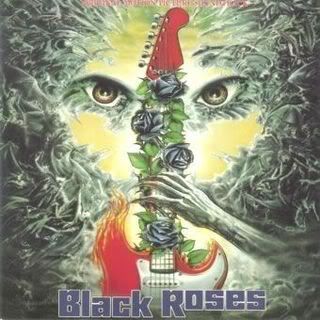
The micro-genre of “metal horror” is made even smaller considering that its two best examples are directed by the same guy. John Fasano struck b-movie gold with Rock and Roll Nightmare, a perfect example of the “so bad its good” genus. The fact that Black Roses is of a considerably higher budget actually creates a new challenge for Fasano; Rock and Roll Nightmare is a blast partly because its so unbelievably cheap (that and the fact that it stars metal-warrior Jon Mikl-Thor). Black Roses does not immediately signify “B” the same way RNRN does from its first frames. Its harder to like, in other words.
The plot of RaRN is strategically confined to one central shooting location and a half-dozen characters. In contrast, Black Roses’ narrative arc involves an entire town, lending what is practically an ensemble cast. The story in Black Roses is something Stephen King could have dreamt up: an upcoming metal band (the Black Roses) book several shows in a small town (somewhere in Canada, from the look of things) to test out new material before launching a national tour, much to the dismay of the town’s adults. Their kids, of course, are thrilled, and Black Roses-mania sweeps through the high school. John Martin plays Mr. Moorhouse, a progressive English teacher who notes a change in his students as soon as the Black Roses flyers start showing up all over town. The Roses’ glam-metal stylings turn out to be so bitchingly bad-ass that they cause average kids to turn into gothed-out murderers. It’s up to Mr. Moorhouse to put an end to the Roses, who may or may not feature Satan himself as lead singer.
Concerns over the PMRC by guys with goatees is a pretty widespread (and rather uncontroversial) cause in art from the 80s and 90s. From Twisted Sister to G’n’R, the impression is that butt-rock and hair-metal are the final warriors in an epic battle in the name of free speech. Figures like Tipper Gore and Joe Lieberman hardly make dynamic villains, so in films like Black Roses demons and killer stereo speakers stand in. This makes for some silly self-mythologizing on the part of metallers and their sympathizers; the idea that drug-fiend womanizers are really standing up for anything is a strange one indeed. However, I do dig the tunes, and like RaRN, the score here offers some stoopid thrills at every turn.
Besides a presentation of the Fear of a Metal Planet, this film offers plenty of cheap-thrill effects scenes, a monumental improvement upon the sock-puppet monsters of Fasano’s previous metal masterwork. The performances are pretty bad, but this only adds to the charm. The personalities are stock, and that’s fine by me. The film visually is interesting, with a large amount of camera variation, from shaky hand-held to neighborhood-surveilling crane shots. Fasano has gone on to direct high-profile television since, but some scenes here point to music-video potential. The concert scenes in both this film and RaRN stand alone as dynamic sequences. I imagine the coveted VHS copies floating around out there look grainy and faded, the recent Synapse DVD looks fantastic.
Aside from its obvious flaws, Black Roses is a fun, fast-moving film. The politics aren’t heavy-handed, and underpin the story in a natural way that allows for Black Roses to exist first and foremost as an old-fashioned gothic horror film. A cheesy gothic horror-film, yes, but a highly enjoyable one at that. While my fellows at Samurai Dreams are divided on this film (Andy digs is considerably more than I; Kevin, Max and James loathe it), I can recommend it with clear conscience. Just don’t get your hopes up for a Thor cameo.
Sunday, September 30, 2007
The October Ordeal
Fall is my favorite season. The strong aesthetic of Halloween I feel as soon as the leaves start to change. I've already noticed that I've been shifting all the horror flicks on my Netflix queue towards the top. Television gets really good come mid-October; I remember taking in Godzilla, William Castle and Hammer marathons with my friends in middle school, back in the days when AMC and TCM would do such a thing.
About two weeks ago I began toying with the idea of doing something here for the month of October. Reviewing a bunch of horror flicks only seemed natural. I began to wonder: how insane would it be to review a film a day, for the entire month? When I thought of a name by which to call this ambitious project, the challenge was official. 31 horror films in 31 days... The October Ordeal.
Let's see if I can pull this off! First up: Video Violence 1 & 2.
About two weeks ago I began toying with the idea of doing something here for the month of October. Reviewing a bunch of horror flicks only seemed natural. I began to wonder: how insane would it be to review a film a day, for the entire month? When I thought of a name by which to call this ambitious project, the challenge was official. 31 horror films in 31 days... The October Ordeal.
Let's see if I can pull this off! First up: Video Violence 1 & 2.
Subscribe to:
Posts (Atom)
