

October 18th: Scarecrows (1988)
Every now and again I'll read about a film and think to myself "Why the hell haven't I heard of this?", especially if the film is of a genre and era I have some familiarity with. While Scarecrows is a very minor cult classic, I'm convinced that if the film had a name or two it would be a much better known horror picture. It certainly is deserving: Scarecrows is really quite good.
Scarecrows takes place over the course of a single night. The premise is simple: a group of ex-military theft a big bag of cash from the Army and escape with a hijacked plane and two hostages. A guy named Bert decides not to share the money and jumps from the plane over an old farm house. The gang land the craft and make chase, only to find an abandoned old farm and some seriously creepy scarecrows staked next to a family graveyard. The folks who used to run the farm--the Fowlers--seem to have migrated from the grave to the rotting scarecrows, and aren't too happy about being invaded. This is what we know, the rest is unexplained.
Thus Scarecrows is extremely short, barely 80 minutes in length. There is no central character, instead an ensemble cast, the actors of mixed ability. While there is barely any back story, there is a lot of set-up. The scarecrows don't even move until about 50 minutes in. While this may be a sure sign of a limited budget, it actually creates a real mood of fear. Each time the camera closes in on a scarecrow, The audience wonder if this will finally be the scene in which one comes to life.
Besides being legitimately frightening, the film gracefully maintains a bleak and moody atmosphere. And while there is some obvious day-for-night shooting, the darkness surrounding the action is quite effective. Interestingly there is almost a total lack of music in Scarecrows; often the airplane's radio or the group's walkie-talkies will stand in for a score. The film looks great, and the camera work is admirable. In most scenes the camera is constantly in motion, panning around, shooting through windows, suggesting the point-of-view of an unwanted prowler.
The film is also admirable for the mistakes it doesn't make. The cast is kept to a minimum, the running length is just right, there is no cumbersome and unnecessary back story, there is no stock nudity, there's no excessive gore, there's no romance, and--thankfully--there is no twist ending. The ending, in fact is great. While a NotLD style stand-off seems inevitable, the film actually takes the climax out of the Fowler's home and through the woods into the getaway plane.
One reason I'm surprised this film isn't better known is that it seems very much of its time. Like Pumpkinhead, this is essentially a morality play. While the thieves become likable as the film progresses, they ultimately must pay for their actions (they have in fact killed many Policemen since the robbery). This aspect also lends the film the quality of a good anthology segment, perhaps as a choice episode of Night Gallery. If I've made my points rather quickly, its because this is a brief, breezy film. No masterpiece, yet fully accomplished. If you have an empty slot on your Halloween-night marathon list, add this one. Your friends will all ask, "How come I haven't heard of this?"
ABOUT THIS BLOG
Friday, October 19, 2007

Thursday, October 18, 2007
The October Ordeal Day 17: Race with the Devil
October 17th: Race with the Devil (1975)
Jack Starrett's Race with the Devil is a trim, confident road-thriller. RwtD simmers for the first two thirds (the way good thrillers often do), establishing rhythm between characters and creating tension, simply by not alluding to any terror to come. This provides necessary context for an extended series of scares in the final act (think Texas Chainsaw Massacre). This model may be named "endurance cinema": the payoff is going to be big, going to be great, only patience is required. And the payoff in this film is fantastic; Race with the Devil really cooks in the final third.
Peter Fonda and Warren Oates star as two old friends on a skiing trip with their wives in a brand new RV, whom stop over in a small Midwestern (I presume) town for some shut eye. Putting a few beers away outside the RV, Roger (Fonda) and Frank (Oates) notice something a bit strange just over the hill. It seems a black magic ceremony is underway, robes and all. Frank and Roger have a great time checking the action out with binoculars, until things get ugly: it seems a human sacrifice is needed to complete the ritual. From here the Satanists pursue the men across the film, on and off the road.
While Starrett claims he cast real Satanists for this early scene, the film is not concerned with the supernatural. Its not really even about the practice of Satanism. We never see these specific people again; there is no villain, there is no mastermind. The threat in the film comes in the form of the automobile, as anonymous trucks pursue the RV Ala Duel.
Oates and Fonda play the only real characters in the film. Loretta Swit and Lara Parker play their wives, yet are completely decorative in function. While many chase movies mythologize the male speedster at the expense of any strong female characters, Race with the Devil is really remarkable in its blatant sexism. The wives here are constantly weeping, and utterly unable to defend themselves or even think rationally in the face of any obstacle. Wives Alice and Kelly are in constant need of consoling from their heroic husbands, and only require that they assert themselves, rather than include them in any strategising or defensive action. In this capacity women are presented merely as cinematic trope, as necessary props.
In fact, male assertion is the theme of the film. In one scene, Fonda stands reluctant with a shotgun before a Satanist climbing through the RV's rear window. Oates, driving, barks, "Do it!" and Fonda fires. The idea, I suppose, is that post-hippie city-boys must regain their manhood via a test, a quest through the unknown wilds of uncivilised America. It always struck me as odd in films like Deliverance that the "city-folk" presented acted pretty much exactly like the hicks they faced off against (except with better teeth, of course).
Alas, this stuff comes with the territory. I'm willing to overlook this particular nastiness out of respect for the excellently choreographed final chase. This sequence is plainly the film's raison d'etre, and it must have been great on the big screen. While the "gotcha!" final reveal I saw coming a country mile away, I was left quite satisfied by this well-dressed, expertly-paced bit of genre filmmaking. Liked Death Proof? Give this one a queue.
Wednesday, October 17, 2007
The October Ordeal Day 16: Black Roses
October 16th: Black Roses (1988)

The micro-genre of “metal horror” is made even smaller considering that its two best examples are directed by the same guy. John Fasano struck b-movie gold with Rock and Roll Nightmare, a perfect example of the “so bad its good” genus. The fact that Black Roses is of a considerably higher budget actually creates a new challenge for Fasano; Rock and Roll Nightmare is a blast partly because its so unbelievably cheap (that and the fact that it stars metal-warrior Jon Mikl-Thor). Black Roses does not immediately signify “B” the same way RNRN does from its first frames. Its harder to like, in other words.
The plot of RaRN is strategically confined to one central shooting location and a half-dozen characters. In contrast, Black Roses’ narrative arc involves an entire town, lending what is practically an ensemble cast. The story in Black Roses is something Stephen King could have dreamt up: an upcoming metal band (the Black Roses) book several shows in a small town (somewhere in Canada, from the look of things) to test out new material before launching a national tour, much to the dismay of the town’s adults. Their kids, of course, are thrilled, and Black Roses-mania sweeps through the high school. John Martin plays Mr. Moorhouse, a progressive English teacher who notes a change in his students as soon as the Black Roses flyers start showing up all over town. The Roses’ glam-metal stylings turn out to be so bitchingly bad-ass that they cause average kids to turn into gothed-out murderers. It’s up to Mr. Moorhouse to put an end to the Roses, who may or may not feature Satan himself as lead singer.
Concerns over the PMRC by guys with goatees is a pretty widespread (and rather uncontroversial) cause in art from the 80s and 90s. From Twisted Sister to G’n’R, the impression is that butt-rock and hair-metal are the final warriors in an epic battle in the name of free speech. Figures like Tipper Gore and Joe Lieberman hardly make dynamic villains, so in films like Black Roses demons and killer stereo speakers stand in. This makes for some silly self-mythologizing on the part of metallers and their sympathizers; the idea that drug-fiend womanizers are really standing up for anything is a strange one indeed. However, I do dig the tunes, and like RaRN, the score here offers some stoopid thrills at every turn.
Besides a presentation of the Fear of a Metal Planet, this film offers plenty of cheap-thrill effects scenes, a monumental improvement upon the sock-puppet monsters of Fasano’s previous metal masterwork. The performances are pretty bad, but this only adds to the charm. The personalities are stock, and that’s fine by me. The film visually is interesting, with a large amount of camera variation, from shaky hand-held to neighborhood-surveilling crane shots. Fasano has gone on to direct high-profile television since, but some scenes here point to music-video potential. The concert scenes in both this film and RaRN stand alone as dynamic sequences. I imagine the coveted VHS copies floating around out there look grainy and faded, the recent Synapse DVD looks fantastic.
Aside from its obvious flaws, Black Roses is a fun, fast-moving film. The politics aren’t heavy-handed, and underpin the story in a natural way that allows for Black Roses to exist first and foremost as an old-fashioned gothic horror film. A cheesy gothic horror-film, yes, but a highly enjoyable one at that. While my fellows at Samurai Dreams are divided on this film (Andy digs is considerably more than I; Kevin, Max and James loathe it), I can recommend it with clear conscience. Just don’t get your hopes up for a Thor cameo.
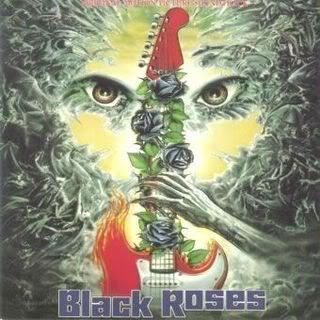
The micro-genre of “metal horror” is made even smaller considering that its two best examples are directed by the same guy. John Fasano struck b-movie gold with Rock and Roll Nightmare, a perfect example of the “so bad its good” genus. The fact that Black Roses is of a considerably higher budget actually creates a new challenge for Fasano; Rock and Roll Nightmare is a blast partly because its so unbelievably cheap (that and the fact that it stars metal-warrior Jon Mikl-Thor). Black Roses does not immediately signify “B” the same way RNRN does from its first frames. Its harder to like, in other words.
The plot of RaRN is strategically confined to one central shooting location and a half-dozen characters. In contrast, Black Roses’ narrative arc involves an entire town, lending what is practically an ensemble cast. The story in Black Roses is something Stephen King could have dreamt up: an upcoming metal band (the Black Roses) book several shows in a small town (somewhere in Canada, from the look of things) to test out new material before launching a national tour, much to the dismay of the town’s adults. Their kids, of course, are thrilled, and Black Roses-mania sweeps through the high school. John Martin plays Mr. Moorhouse, a progressive English teacher who notes a change in his students as soon as the Black Roses flyers start showing up all over town. The Roses’ glam-metal stylings turn out to be so bitchingly bad-ass that they cause average kids to turn into gothed-out murderers. It’s up to Mr. Moorhouse to put an end to the Roses, who may or may not feature Satan himself as lead singer.
Concerns over the PMRC by guys with goatees is a pretty widespread (and rather uncontroversial) cause in art from the 80s and 90s. From Twisted Sister to G’n’R, the impression is that butt-rock and hair-metal are the final warriors in an epic battle in the name of free speech. Figures like Tipper Gore and Joe Lieberman hardly make dynamic villains, so in films like Black Roses demons and killer stereo speakers stand in. This makes for some silly self-mythologizing on the part of metallers and their sympathizers; the idea that drug-fiend womanizers are really standing up for anything is a strange one indeed. However, I do dig the tunes, and like RaRN, the score here offers some stoopid thrills at every turn.
Besides a presentation of the Fear of a Metal Planet, this film offers plenty of cheap-thrill effects scenes, a monumental improvement upon the sock-puppet monsters of Fasano’s previous metal masterwork. The performances are pretty bad, but this only adds to the charm. The personalities are stock, and that’s fine by me. The film visually is interesting, with a large amount of camera variation, from shaky hand-held to neighborhood-surveilling crane shots. Fasano has gone on to direct high-profile television since, but some scenes here point to music-video potential. The concert scenes in both this film and RaRN stand alone as dynamic sequences. I imagine the coveted VHS copies floating around out there look grainy and faded, the recent Synapse DVD looks fantastic.
Aside from its obvious flaws, Black Roses is a fun, fast-moving film. The politics aren’t heavy-handed, and underpin the story in a natural way that allows for Black Roses to exist first and foremost as an old-fashioned gothic horror film. A cheesy gothic horror-film, yes, but a highly enjoyable one at that. While my fellows at Samurai Dreams are divided on this film (Andy digs is considerably more than I; Kevin, Max and James loathe it), I can recommend it with clear conscience. Just don’t get your hopes up for a Thor cameo.
Tuesday, October 16, 2007
The October Ordeal day 15: The Incredible Melting Man
October 15th: The Incredible Melting Man (1978)
(Spoilers, but who cares?)
The Incredible Melting Man may be a drive-in sci-fi/horror film from the 70s, but it feels more like a cheap 50's monster flick (Hideous Sun Demon specifically). A guy (Alex Rebar as Steve West) goes into space (to Saturn, actually) and comes back as a melting maniac compelled to kill.
Like Octaman, this film boasts early Rick Baker makeup effects. The melt-fx look fine, but rather average for the era. This is an extremely average film, fitting all the stereotypes of the worst in an already maligned genre (The Clones is similar in its uniform dullness). A pattern develops early on: the local sheriff and some doctors run around looking for Melt-face while he murders whoever happens to be wandering the country side. Featured is Burr DeBenning as Ted Nelson, former friend of Steve's.
Each of these scenes last so long they nearly morph Incredible Melting Man into an anthology film; this makes sense, each attack necessarily pads out the film. Melt-face attacks a group of kids, some fishermen, young lovers and tramps hanging out by the tracks. In fact, the entire film feels padded: it even seems to wait for its own end impatiently. Even though TIMM is less than 85 minutes long, it feels like dull, lifeless eternity.
The tone of this film is strange. While a guy melting to death might lend a seriocomic element to any horror film, at times Melting Man feels downright slapstick. In one nonsensical sequence, Nelson's mother-in-law wanders around trying to pick wild lemons... to circus music. The dialog in this scene is beyond inane.
From the Vestron cover art, I assumed The Incredible Melting Man would have something in common with Frankenhooker or Slime City. While this film and Slime City share a similar plot, they could be no different in tone. The only interesting thing in this film is the ultra-bleak ending: some cops shoot Nelson in a moment of confusion, Melting Man regains his identity momentarily, kills the cops and then melts to death. If this isn't depressing enough, the credits roll to a radio message announcing further trips to Saturn (think the final moments of Mutant or Rabid). A quiet moment belies the fact that the world is about to fall apart. If only the entirety of the film could have mined this one scene for its dark potential.
Monday, October 15, 2007
The October Ordeal day 14: Slime City
October 14th: Slime City (1988)

Of all the low-budget trash horror flicks (and I’m talking low) of the 80s, the cheapo gore fests filmed in New York City seem to have the most life. When you watch a film shot in who-knows-where with a cast of eight and only two or three sets, it seems fake, the budget limitations obvious. Something about this same strategy works if the film is set in a big city however; it’s somehow believable that in a city so large and dense a gruesome scenario could play out behind closed doors without anybody noticing. We get that it’s a big city, so instead of wondering where everybody is, we are simply unsettled by the fact that a character in a place so packed could be so isolated. Yesterday I reviewed Frank Henenlotter’s Frankenhooker, a gory flick placed in NYC. His earlier picture Brain Damage benefits further from this quality. The director of Slime City, Greg Lamberson, is credited as first AD of Brain Damage, so these two films share more than just the same aesthetic, they share the same DNA.
Shameless sleaze-merchants Camp Video can actually count Slime City as one of their higher-budget releases, if you can believe that. Camp’s recent DVD releases (mostly of SOV obscurities) claim “The Awesome 80s are Back!” Well, back in the VHS days, their logo read “Your Ticket to the Future.” Whether Camp looks forward or backward depends on the market I guess. Whatever the case, Camp knew their target in ‘88: the box boasts “A horror film with guts!”

The guts in question belong to our man Alex (Robert C. Sabin, fresh off the no-budget I Was a Teenage Zombie), a starving artist who works at a video store (see also: Night Vision, Remote Control, Video Violence). Alex may be an underground painter, but he acts like a typical frat boy. This is the type of character you only find in horror and soft-core porn. Alex’s major dilemma in life is that his square girlfriend Nichole (Mary Huner) won’t have sex with him. T.J. Merrick plays his stock best friend Jerry, a creep who drools over Alex’s goth neighbor Lori (arbitrarily also played by Huner).
Alex has just moved into a new apartment, a decent room in a decaying building. Roman (Dennis Embry), an unhinged guy from the floor just below, initiates him into a black magick cult by feeding him green yogurt and putrid wine, which all the tenants consume. The confusing origin of the cult involves alchemy, suicide pacts, murder and reincarnation. Soon after, Alex becomes addicted to the slime, and unless he murders bums and prostitutes, his face will melt. Doesn’t make sense, but allows for some interesting sequences. Alex goes through the same sort of bodily ordeal seen in Henenlotter’s films, or Cronenberg’s, a clear influence on the entire gore crowd (there’s even a handful of obligatory bathroom mirror scenes). As Alex becomes more and more addicted to the slime and the subsequent killing, he feels alienated from his friends, even though he’s reluctant to commit fully to the cult living all around him.
In the final scene, it’s a face-off (can I say it? Literally) between Alex in full-on melt mode and Nichole, who causes all kinds of harm to Alex using various kitchen appliances. This effects-heavy scene is what has gained Slime City its minor notoriety. Yet, as with Henenlotter’s films, the gore here is not what interests me. This is a fun, trashy flick which confidently allows its aesthetics to be the substance. The riff-raff populating the film create an idealized NYC; this is a love letter to scum. The crumbling buildings, drug addicts and prostitutes here seem to represent an era that maybe shouldn’t have been idealized, but nevertheless was and is. In such a cinematic environment, a mobile brain escaping from a severed head seems slightly less weird.
Special attention must be paid to Slime City’s fantastic score. Robert Tomaro’s original songs sound like something from a Messthetics compilation, and remind me specifically of the L.A. synth-punk bands, especially Nervous Gender and the Screamers. Synth and piano dominate, but jagged edges of surf, dub, jazz and minimalism jut out as well. While New York’s rich underground history has been well-mined, the trash-synth soundtracks to many NY underground gore flicks have yet to be revisited.
Saturday, October 13, 2007
The October Ordeal Day 13: Frankenhooker
October 13th: Frankenhooker (1990)

Once in elementary school a kid told me that he and his cousin had cut up a Playboy magazine in order to construct the “perfect woman.” This seemed really strange to me at the time, as I imagined attractive parts actually looking rather nightmarish when combined. Well, perhaps Henenlotter once did the same thing; if he didn’t, he gets to do it here. Protagonist Jeffrey Franken (get it?) is a failed surgeon who works at a power plant in New Jersey. When his fiancée dies in a freak lawn-mower accident, he gets to construct a new and improved version of Elizabeth Shelley (get that one too?) from scratch, utilizing his unique skill-set. Since most of Liz (Patty Mullen) is chewed to bits, he has only her severed head to work with. Jeff’s problem (and—in his mind—an opportunity) is that he needs to find replacement parts somewhere.
One thing that’s always struck me about Henenlotter is that his films are extremely economical. Here, you know all you need to know before the title card, and the rest of Frankenhooker is open for gags, gore, and plenty of stray ideas. Henenlotter here seems concerned with the same themes present in Brain Damage and Basket Case, and elaborates these ideas further and with greater clarity. Also, the tone of this film is quite different. The laughs are more genuine here, as the bleak tone of Basket Case is completely absent. This is a wild and thrilling film, well-paced and bursting with gross-out humor. The budget is also considerably higher, thanks to the investment of producer James Glickenhaus, the director of Exterminator, who brought much of his regular crew along.
The point is clearly made here that while Jeff wants his girlfriend back, he also sees her accident as a perverse opportunity to construct his own super-model fantasy. Jeffrey is a flawed character, but Henenlotter still clearly wants us to like him in spite of this. As Dr. Franken, James Lorinz isn’t a great actor, but he’s well cast here. Henenlotter’s protagonists are never played by the most talented performers, he seems to cast for some schlubbish quality rather than chops, which is fine. It works. While Jeffrey is quite average in many ways, there’s a heightened strangeness about him that Lorinz conveys nicely. How many mild-mannered med-school drop-outs regularly drill holes in their cranium to stimulate creative thought? This trepidation motif is nicely carried over from Brain Damage.
Come to think of it, Henenlotter’s protagonists are all well-meaning but totally selfish obsessives, dedicated to one strange goal: Duane in Basket Case is wholly devoted to the well-being of his brother Bilal; Brian in Brain Damage needs the parasite Aylmer to get high. Jeffrey’s quest to bring Liz back from the dead is both pathetic and touching. In his single-mindedness he never pauses to question his true motives. In one hilarious scene Jeff asks Liz’s severed head: “Honey can’t you picture yourself in this body, kneeling on ma’s couch in the basement?”, while pointing to a centerfold model. His world-view, like much in Henenlotter’s world, is candidly low-rent.
Where does Jeff go to find the “spare parts” he needs? Across the bridge to NYC of course, Henenlotter’s home and creative inspiration. Jeffrey sets out to find a half dozen prostitutes, whom together have the different body parts he needs. Jeff is conflicted in that he isn’t a murderer, but his stubborn determination forces him to rationalize and justify any wrong-doing on his part as an unfortunate necessity. “I can’t feel guilty now. I just wanna make life” He tells himself. In order to feel that he is not responsible, Jeff sets up a scenario so that he himself does not have to perform the act himself, he merely has to create the ideal circumstances. He finds an ally in the bane of the film’s prostitutes: crack cocaine. Jeff synthesizes a “super-crack” which causes the smoker to explode into a heap of junk limbs. Carrying a bag full of eviscerated bodies to his trunk, he promises he’ll bring them all back once he’s got Liz among the living.
With the introduction of crack into the film, a clear line is traced from the anti-drug themes of Brain Damage. While Brain Damage feels a bit short-sighted and reactionary, Henenlotter adds layers of complexity to what it still essentially the same argument here. While in Brain Damage avoiding Aylmer’s addictive juice is simply an act of initial will power, here the message is matured. Henenlotter admits the solution to the problem of addiction is much bigger than “Just Say No.” Jeffrey even, in a moment of intentional ignorance, even recites the slogan. Jeffrey himself, however, is an addict: he’s addicted to his power drill. He also uses drugs to manipulate others, and is mirrored by the pimps who populate the film.
 Once he has the raw material, Jeff assembles Elizabeth and sends her on a raised platform into a raging storm. In a technically impressive scene, bolts of lightning bring the patchwork Liz back into the living world. She looks quite monstrous of course, her skin a mosaic of different color tones and textures, stitched together with huge medical staples. He hair is also bright purple, somehow changed by the bolt. Patty Mullen as zombie-Liz is both attractive and repulsive, much like Elsa Lanchester as the original Bride of Frankenstein.
Unfortunately for Jeffrey, she’s not the Liz he once knew, as all the women he murdered to recreate her have lent her pieces of their psyches as well as their bodies. She becomes a kind of ur-prostitute, bent only on drugs and money. Her mad mission is parallel to Jeff’s, in fact. Her mantra: “Got any money?” All of her lines are actually cribbed dialog from earlier in the film. As there is an unusual amount of characterization for a genre film, its even possible to notice individual personalities bubbling to the surface. Re-animated Liz leaves Jeff baffled and heads for New York, her clunking Frankenstein pumps a nice touch. The following scenes are great: sleazy, neon and wonderfully time-stamped (the Batman logo is everywhere).
(spoilers in this section)
After Jeff finds Liz he re-zaps her and manages to momentarily bring back the woman he knows and loves. In the film’s smartest scene, she chides Jeff for his mad quest, and realizes that his selective reconstruction has afforded him certain chauvinistic luxuries, granted without her consent or approval. This moment is short-lived however, as what follows is not only the film’s climax but its goriest moment. Sadistic pimp “Zorro” has followed Jeffrey home, and has finally figured out what happened to his “employees.” Zorro (Joseph Gonzalez from Brain Damage), in a surprising moment, cuts Jeff’s head clean off. After this, Jeff’s storage tank flips over, and the reconfigured prostitutes from earlier in the film spill into frame. Don’t ask how, but the parts have assembled themselves into monstrosities Brian Yuzna may have taken note of. Here the effects come courtesy of Henenlotter collaborator Gabe Bartoloz. The flesh-beasts drag Zorro into the tank and close the lid, leaving the rest to the viewer’s imagination.
(major spoiler here)
In the film’s final moment (which is also the final gag), Liz reconstructs Jeff. But since his mystery serum is estrogen-based (did I forget to mention that?), she needs the leftover parts of women to bring him back to life. Jeff’s lesson is learned here via his castration; it’s a great gag, yes, but it also sums up the entire film in a really smart way. Jeffrey’s quest to create the perfect woman at the expense of all others is reversed; he himself must become that ideal woman. Roles here are also reversed. While I don’t think Henenlotter is that deep, this scene brings into question the validity of essentialist ideas about men and women, at least implicitly. So much of 80s horror is informed by Reagan’s mad rule. While Frankenhooker was filmed in ‘89, as Reagan had left office, he feels present here. While Henenlotter has intelligent things to say here about the failed war on drugs, his strongest move is to cut the predatory yuppie male’s dick off.
It’s clear from the relatively few films Henenlotter directed that he knows his craft. If things had gone a different route, he could have parlayed his low-budget, less-is-more visionary talents to mainstream success, like Raimi or Jackson. He stayed true to his roots instead, putting his time into Something Weird, unearthing lost cult films for DVD. While I find much of Something Weird to leave a sour taste, I admire his commitment. A look on IMDb reveals he’s completed work on a curious new picture, one co-written by shock-rapper R.A. the Rugged Man and featuring many underground-rap stalwarts. While I now find Vinnie Paz and Reef’s faux-underground gun rap unbearable, I would have been hyped up if this film came out five years ago, when I couldn’t get enough of underground “horror-core” hip-hop. We’ll see.
Slime City tomorrow! Black Roses soon!
The October Ordeal Day 12: Necropolis
October 12th: Necropolis (1986)
Cop out time-- this is an old review, reposted. There was simply too much going on today. Tomorrow I start the gross-out series with Frankenhooker!
This is a strange review. I don't write like this anyone.
I had very low expectations of Necropolis. James and I both wrongly assumed this was a post-apocalypse flick, seeing the case frequently at the North Adams library. A while back, Kevin checked it out, and I decided to throw it on. The cover features a burning NYC cityscape and offers an “action-packed zombie thriller.” Well, there are no zombies that I could see, and Necropolis is neither thrilling nor action-packed (that is to say, it’s neither a thriller nor an action film). It’s actually about a group of people united by and throughout time, who reincarnate repeatedly as a group dedicated to fighting the Satan-worshipping Eva, who’s now cruising around New York collecting minions and searching for a mystical ring and its bearer: priest Henry James (hmm…).
Eva is a cool character, a punky chick who’s like a trashier version of Anne Carlisle (writer and star of Liquid Sky). When I watched Necropolis initially, I was feeling kind of dragged down, and the film didn’t make me feel any better. Its low-budget junkiness and gross-out effects just added to my gloom. Well, I got a chance to watch the film again when Andy gave me a copy for my birthday (this review has mentioned nearly every writer for SD—it’s not that we live in some kind of cult-film commune or anything, its just that we share a kind of collective trash-culture consciousness, and often synchronously pick things up). After a second viewing, I can honestly say I really like Necropolis.
The beginning is really hyped-up and fun, as we meet our principles in a previous incarnation, and Eva does a satanic strip-tease in front of a giant pentagram. Fast forward to the present (the mid eighties): Eva is now reincarnated as a no-nonsense punk rocker, who cruises around the city on a motorcycle, while ultra catchy synth tunes blast in the background. Circumstances lead Father James, a London ex-pat named Dawn, and her Italian stereotype detective boyfriend together as they unravel the mystery, and go up against the satanic powers of Eva and her ghouls.
There’s a lot of random weirdness in this film: in one scene the ghouls nurse ectoplasm from Eva’s breasts (which she has six of in some scenes), and a bed in an alleyway is played as Dawn’s apartment (it’s really obvious; I mean, the budget is obviously low, but the filmmakers couldn’t find a bedroom to shoot in?). One interesting thing about the film is that is positions both reincarnation and Christian theology as non-conflicting forces. Note: the VHS case for Necropolis has three large taglines distributed on the front and back: City of the Dead; Beneath Hell lies Necropolis; and one that makes me think the Misfits may have seen this flick: It’s the Ghouls Night Out!
Friday, October 12, 2007
The October Ordeal Day 11: Thirst
October 11th: Thirst (1979)


Rod Hardy’s Thirst, while shot in Australia, has a lot in common with English and Italian thrillers. Short on logic, the film communicates its style first and foremost: brooding, brutal, cold and claustrophobic. The pulp acting and lyrical dialog remind of Italy’s genre films; what’s substantial in most narrative films is merely ornamental here.
So I wasn’t alarmed when ten minutes into the film I had no fucking clue what was going on. Half the scenes in Thirst are revealed to be dream, hallucination, or drug trip. The diegesis of the film is splintered and notional; Thirst could be chopped up and rearranged in any way.
Thankfully, Thirst isn’t overloaded with characters, as films of this nature often are. Chantal Contouri is totally game as Elizabeth Bathory’s direct descendent Kate Davis. Shirley Cameron (credited as “Ms. Cameron”) plays an ice-queen cult-leader who’s definitely been reading Ayn Rand. David Hemmings, at the beginning of his fat-phase, is Cameron’s mad doctor Fraser. Henry Silva hangs out--as far as I can tell that's his only purpose here. Cameron and co. kidnap Davis and take her to their Jonestown-esque compound for conditioning (complete with machine gunning guards). Turns out she’s genetically predestined to love the taste of blood, which our villains claim is the source of ultimate power. This isn’t a vampire film, although the standard vamp imagery and symbolism are evoked with glee. The film is actually about a gang of neo-fascists systematizing the Big N’s “will to power.”
This isn’t my own observation, as the film’s characters take every opportunity to proclaim as much. Cameron gets the best lines (“[Drinking blood] is the ultimate aristocratic act.”), including a monologue theorizing the revulsion people feel when witness to violence is actually veiled attraction. Our natural state, she claims, is to crave power, here represented by sweet, sweet blood. The blood’s not for everyone though. The cultists keep stores of “Bloodcows,” on-hand. These willing young WASPS hang out by the pool all day, happy to donate the occasional pint. I guess all you need to attract a slave-class is a bitchin' pad. These dozy kids look like they wandered off the set of Logan’s Run.
 Kate isn’t down with this scenario. So she’s drugged, and spends most of the film running through her own mind. Hemmings as Fraser dopes her with some mystery serum to induce “90-minute” composite memory hallucinations grown from favored past-events. Once this motif begins, it becomes impossible to tell dream and reality apart. Often scenes will telescope out via false awakenings until not even the script is sure which is which.
The film’s endless pile-ons do becomes tiresome eventually. As the conditioning sequence drummed on I began to suspect that the film’s running time was merely being padded out. That, or the producers wanted a reason, any reason, to place nudity in the film (via Kate’s occasional sex-dreams). Its an over-long excursion for such a short film (about 90 minutes, actually… Hmmm). The ending is just as confusing as everything else here, and whether Kate feeds or not is a mystery. The twist of all twists at the very end is less a denouement than simply another head-scratcher.
I must mention Bryan May’s excellent score. May is something of an unheralded genius. His versatile scores have enlivened many Australian films, including Mad Max and the films of Brian Trenchard-Smith. Here, May’s score morphs from Sci-Fi treble pulses to buzzing white-noise to Debussian string-swells. The key word is sustain. I dig the score so much I’m considering purchasing the OST album from Movie-Grooves.
Is this a great film? Not really. It is however, a solid genre entry. If you dig this sort of thing, go for it. You could do worse. If for no other reason, watch this to see Silva make a strong impression merely by standing in the background and smirking.
Tomorrow I begin one of two cycles. I’ve got some Gialli coming in the mail from Netflix. If the post is late I’ll start a gross-out circuit including Slime City, The Incredible Melting Man and Street Trash. I’ll be taking in some heavy audio-horror tomorrow, as I head to Hampshire College to catch Wolf Eyes. I’ve gone to see a lot of bands these past few months, but this is the most amped-up I’ve been for a show in ages.
Thursday, October 11, 2007
The October Ordeal Day 10: Mutant
October 10th: Mutant (1984)
 Once our gang figures out what’s going on, it’s too late to do anything except hide. In the film’s best scene, Josh and Holly find Doc Tate’s OR trashed, blood everywhere. Finding the Doc’s tape recorder, Josh plays back her last autopsy report, which quickly turns into the soundtrack to her murder. As tinny screams play on the tape, hand-held camera violently scans the wreckage of the destroyed room, Josh and Holly standing motionless. The frenzy of the sequence is remarkable. As artful at this scene is, it’s immediately followed by a poorly-lit (although my worn Vestron vhs may be the culprit here) zombie chase. This is the film’s downfall: something rather good is followed by something rather bad (the bad often a genre convention poorly played). This discord is eased by Richard Band’s dynamic score. I like Band’s Full Moon work, but this is subtler—and ultimately better—work.
The final moments of the film are overwhelmingly desperate. Things really do seem hopeless. In one scene, Holly and Josh share a quiet moment while making Molotov cocktails in an abandoned grocery. Wings’ presence in this scene is undeniable, and he proves that subtly isn’t actually beyond his ability. Its too bad the character is given almost no substance (via a back-story, a rounded personality, etc).
(Also known as Night Shadows.)
 If there is one actor who’s truly captured the collective heart of Samurai Dreams, its Wings Hauser. The man is a maniac. The man is an uncontrollable force of nature. Wings doesn’t chew scenery, he eats it alive. Yet every now and then, Wings proves he can actually act. Check him out in Vice Squad, The Wind or Norman Mailer’s Tough Guys Don’t Dance. And while Mutant is no masterpiece, Wings reins in his Wagnerian instincts enough to turn in an atypical low-key performance.
Low key or not, however, Wings is incapable of playing an everyman. Here he plays a man who’s written as such, but his idiosyncrasies as an actor override the character. Wings plays Josh Cameron, a guy with a strange sense of humor who’s on a backwoods road trip with his younger brother Mike Cameron (no relation to the prankster who famously wore a Pepsi shirt to school on “Coke Day”). Lee Montgomery plays Mike as a whiny city-boy, who’s happy to spend time with his brother after a messy break-up, but doesn’t trust the small-town roads. And with good reason. No sooner than they pass into one particularly insular town, the two brothers are run off the road by a particularly ornery batch of rednecks. Their car busted, Mike and Josh are forced to venture into town. Finding a few friendly folks, Mike and Josh decide to stay the night at a local bed & breakfast. Josh’s ordeal begins in the morning, when he awakens to find Mike missing from his room.
Josh finds allies in the town doctor, Myra Tate (Jennifer Warren, turning in a competent performance), local teacher Holly Pierce (Jody Medford as Wings’ love interest), and the inimitable Bo Hopkins as the soused Sheriff Will Steward. These four characters seem to be the only sane component of Goodland, GA, and that’s not just because toxic waste is turning denizens into cannibals. The evil town is a convention as old as the horror genre itself, one that surely predates film itself. How many horror films feature a city-boy learning all about country folk the hard-way? Plenty.
Josh soon realizes that the mystery of Goodland is deeper than the location of his lost brother. It seems like everyone’s coming down with a strange “virus,” and this may have something to do with a sharp increase in zombie activity. About mid-way through, Mutant becomes a somewhat different film. The desolation of Goodland is almost tangible, as more and more people fall off the charts. The deserted-streets motif is really attractive to me. This spooky convention helped to shape the aesthetic of many films; the Phantasm sequels for instance.
 Once our gang figures out what’s going on, it’s too late to do anything except hide. In the film’s best scene, Josh and Holly find Doc Tate’s OR trashed, blood everywhere. Finding the Doc’s tape recorder, Josh plays back her last autopsy report, which quickly turns into the soundtrack to her murder. As tinny screams play on the tape, hand-held camera violently scans the wreckage of the destroyed room, Josh and Holly standing motionless. The frenzy of the sequence is remarkable. As artful at this scene is, it’s immediately followed by a poorly-lit (although my worn Vestron vhs may be the culprit here) zombie chase. This is the film’s downfall: something rather good is followed by something rather bad (the bad often a genre convention poorly played). This discord is eased by Richard Band’s dynamic score. I like Band’s Full Moon work, but this is subtler—and ultimately better—work.
The final moments of the film are overwhelmingly desperate. Things really do seem hopeless. In one scene, Holly and Josh share a quiet moment while making Molotov cocktails in an abandoned grocery. Wings’ presence in this scene is undeniable, and he proves that subtly isn’t actually beyond his ability. Its too bad the character is given almost no substance (via a back-story, a rounded personality, etc).
Even though the ending seems hopeful (the chemical plant responsible for the virus is shut down), the momentary victory of Josh, Holly and the Sheriff is shattered by the downbeat voice-over which ends the film: the company responsible has already begun building new plants across the state (despite this late edition to the film, it doesn’t seem justified to call Mutant a political film; there’s no explicit environmentalist theme). While the radio announcer’s message is bleak, the relieved smiles of the three surviving characters may not point to irony or pessimism, but ultimately the virtue of hope, no matter how fleeting. I can’t say if this is the right interpretation, but this is certainly how Wings plays it.
Wednesday, October 10, 2007
The October Ordeal Day 9: 976-Evil
October 9th: 976-Evil (1989)
Robert Englund may have picked up a few ideas for his directorial debut watching Wes Craven work; 976-Evil is very much in the style of Craven's 80s output. Unfortunately, this film is quite unexceptional. Englund’s direction is competent, but the film itself is middle of the road: not great, not horrible, just very low-key and unambitious.
976-Evil is a tale of Satan-sponsored nerd-rage revenge (a premise also found in such middle-of-the-road pictures as Evilspeak and The Gate 2). The nerd here is repressed mama’s boy Hoax (that’s really his name), a straight-A student living in awe of his biker cousin Spike. Spike is the black sheep of the family, who’s mother has recently died. His aunt is Hoax’s Christian-Fundamentalist mother Lucy (Sandy Dennis), a cat-collecting fanatic who’s withholding Spike’s inheritance until he turns 18, essentially keeping him hostage.
Despite this unhealthy living situation, things are going alright, until Spike (Patrick O’Bryan) finds an ad for daily “Horrorscopes” in a porno mag. “Dial 666-976-EVIL” the ad says. Drunk enough to try it, Spike calls and inadvertently opens the gates to hell. A strange voice on the other end gives him situation-specific bad advice. With Spike, the advice is about misdemeanor-level. When Hoax (Stephen Geoffreys) decides to call, things get much more intense. In the film’s pivotal moment, Hoax follows Spike and his girlfriend Suzie (Lezlie Deane) to the movies on a date. Spike is derailed at the entrance by his loser pals, all gambling addicts running a high-stakes game in the projection booth (the set for these games is fantastic, with Black Flag and A Clockwork Orange posters everywhere). Hoax shows up to intercept a very pissed-off Suzie. Their first date at a pizza joint is going smoothly, until Suzie finds a pair of her panties in Hoax’s back pocket(!), and storms out. Hoax over-reacts a bit and hexes Suzie in a black-magic ritual involving a giant pentagram and a pizza plate full of poisonous spiders. From then on Hoax becomes an elf-faced demon with claws and a pitch-shifted voice, and its up to Spike to send him back to Satan, with the help of the school principal and a private investigator (J.J. Cohen and Maria Rubell as stock support).
976-Evil is stuck in neutral right until the end. It never takes off. The spark of life found in even Craven’s worst films is missing here. Englund clearly had a lot more to learn. That said, its competent; had the script and actors been upgraded, this could have been a good film. As it stands, 976-Evil is as average as it gets. There is a sequel, which I will try to seek out in the coming weeks.
Tuesday, October 09, 2007
The October Ordeal Day 8: Hobgoblins
October 8th: Hobgoblins (1988)

Robert Zajonc, along with Greg Markus, developed in the ‘70s a theory he called the Confluence Model (this idea is sometimes referred to as “youngest child syndrome”). The basic idea is that birth order has something to do with intelligence. During development, the first-born child has the advantage of an all-parent environment. Subsequent children must compete for attention, and also have their older (still developing) siblings for intellectual models. While a problematic theory, there is some evidence to suggest that, statistically, the younger the child, the lower the IQ. The baby of the family has the extra disadvantage of having no younger siblings to “teach,” and often tests lower than the next-youngest child considerably. With this theory in mind, consider the fact that Gremlins came first in 1984, then Ghoulies in ’85. Critters followed in 86, Munchies in ’87. A year later, our severely disadvantaged subject appeared, a film known as Hobgoblins.
I saw Hobgoblins on the shelf at Astro Video probably ten times before I decided to buy it. Eventually me and my dollar bill parted, and Hobgoblins became mine. The film sat on my shelf for months, until I decided, today, to watch the damn thing. I had a bad feeling when I noticed the twin logos on the back of the VHS box: Trans-World Entertainment and Goodtimes. TWE and Goodtimes are two of the worst video distributors ever, companies whom often released films in EP mode to save money. T-WE is a bit more obscure, but anyone who’s ever bought a DVD at the dollar store may recognize Goodtimes’ logo. I once bought a Goodtimes release of Fists of Fury that didn’t include the entire film, just the 45 minutes of it that would fit on the tape. Over at Critical Condition you can find write-ups on both of these fifth-tier VHS villains.
When I began the film, things didn’t seem so bad. Old man McCreedy (Jeffrey Culver) is training a new kid on the lot. McCreedy for thirty years has been the night-watchmen at an unused Hollywood lot. Phasing McCreedy out, the higher-ups are hiring young punks to take his place. McCreedy tells the kid, “don’t go in the vault.” Kid goes in the vault. We don’t see how or why, but the kid ends up torn to shreds. Cue music, cue credits. So far so good. I can get on board with something dumb and derivative, as long as it's fun. The fun in Hobgoblins is extremely fleeting however; it ends here.
Its time for a new recruit, and a dude named Kevin (Tom Bartlett) gets the gig. Kevin’s a bit smarter than the other guys, but he still can’t stay out of the vault. When a prowler breaks in, Kevin accidentally lets whatever’s in “the vault” out, and we see the Hobgoblins for the first time, but unfortunately not the last. This scene explains why it took a half hour for the little trolls to show up. We see three or four inanimate dolls sitting on a golf-cart, cruising around to zany synth music. The Hobgoblins aren’t puppets, they’re toys. They don’t move. Let’s just say there’s a lot of scenes where characters catch the goblins when a prop guy throws them from off-screen and hold on to them while pretending to fight them off.
McCreedy tells Kevin that the beasts are from outer space, and that they use psychic powers to lull their victims into trances via there own subconscious fantasies. OK. So Kevin is given a group of friends (roommates?) who all embody cliché 80s personas, so that they may be “cleverly” flipped by the Hobgoblins to show us who they really are. The prudish girl wants to strip in a punk club, the nice guy wants to prove himself, blah blah blah. These characters are unbearable. They all seem to hate each other as well. Including average Joe Kevin, this is truly an unlikable gang of losers. One of the gang, the macho Nick (Billy Frank), is an Army recruit, who carries grenades in his glove compartment. These scenes reminded me that the unhinged military gun-nut psychopath is actually a pretty common character in 80s comedies. I guess it takes a few years without a visible war to bring this stock character back into the culture.
This soulless film is one of the worst I’ve seen in a while. It manages to be simultaneously boring and infuriating. Hobgoblins is overlooked, and rightly so. I recall that Astro Video still has a few more copies. Don’t buy it, unless you plan to bury it ten feet into the ground. A quick look on IMDb reveals that director Rick Sloane has had a lucrative career in softcore porn, and has completed the filming of Hobgoblins 2. He also directed the Wings Hauser dud Mind, Body and Soul. Great. I can’t say any more about this film because, well, its giving he a headache.
Its tough being the youngest child.
Sunday, October 07, 2007
The October Ordeal Day 7: Long Distance
October 7th: Long Distance (2005)
A visit to the local big-box video store will reveal that contemporary American direct-to-DVD horror films come in (mainly) two varieties: the vulgar Photoshop no-brainers like Frankenfish or Leprechaun in the Hood 2, and the stuff that, if it had featured a star, could have been in theaters. If Long Distance had nabbed Halle Berry or Angelina Jolie instead of Monica Keena, it could have bombed at the box office instead of Blockbuster. Most of these films are as bad as Frankenfish, but every now and then something really interesting slips through the cracks (see Friday’s film, Chasing Sleep, or Stuart Gordon’s King of the Ants). Unfortunately, Long Distance is not in this category.
Marcus Stern’s first film Long Distance is a film with a tiny budget. Excepting one short scene, the entire story takes place inside an apartment complex, really one apartment. There are about four developed characters, and less than a dozen altogether. Many of the actors are represented in voice only. A film with such restrictions is often classified de facto as an art film (evidenced by this film’s appearance on the Sundance network). Actually, Long Distance is a limp psychological thriller with aspirations to complexity greater than its ability to deliver.
Monica Keena isn’t a great actor, but she is very likable. In Freddy Vs. Jason, her performance is appropriately all-surface. Her big eyes and expressive face communicate very well in such a film. And she was quite charming on the small screen in Judd Apatow's Undeclared. Also, she can scream. Here, an actor capable of subtlety could have saved Long Distance from its script. Keena plays Nichole Freeman, a grad-student studying Psychology in Boston. She’s just broken up with her boyfriend, Chris, and calls her mother to talk about it. She makes a mistake and misdials, reaching a strange answering machine. A minute later, an unknown man with a creepy voice calls, asking “Why did you call me?” Turns out the guy is a serial killer calling himself Joe (as in “average Joe”), who’s just murdered the owner of the cell phone. Joe (Kevin Chapman) decides to call Nichole before every subsequent murder, leaving the phone on so that she can hear his victims screaming for help. Keena spends many of the film’s remaining scenes on the phone (she does have an expressive voice, fortunately).
When the cops find a corpse with a cell phone, they send Detective Frank Halsey (Ivan Martin) to Nichole’s apartment, to question her about the dead woman’s last outgoing call. From then on Frank remains in Nichole’s apartment, as a tech guy (Tim McIntire as Charlie) back at the station traces Joe’s calls (always too late, of course). The FBI sends over expert profiler Margaret Wright (Tamala Jones, pretending she’s in a CSI episode) to coach Nichole on how to keep Joe on the line long enough for Charlie to trace the call and dispatch the police in whatever town Joe is in. Throwing some pins in a map on the wall, Frank realizes that Joe is traveling in an arc across the country, Boston his next location.
A straight-forward conclusion would have been welcome. Instead, (a spoiler here) Long Distance ends with a lame twist, re-framing the entire film as a psychological fiction. While dream sequences throughout the film hint at this, and certain aspects of the script make sense as fantasy (the Hollywood romance that develops between Nichole and Frank), this final reveal is truly groan-worthy. When Joe shows up, things start to get weird, and we realize that Joe (spoiler) may not even be real at all.
Long Distance plays a slasher premise seriously. Fine. Yet, Long Distance could have been a more traditional slasher. The film would have been simpler, yes, but probably better. Every horror film doesn’t have to be as psychologically complex as Silence of the Lambs—especially if the screenwriters (here Shawn and Michael Rasmussen) aren’t up to task. There’s nothing wrong with a good twist; there is something wrong with an unearned one. The final scene in Long Distance is clumsy and confusing. Keena’s performance doesn't have the layers necessary to sell the revelation that she’s dreamt up an entire narrative to hide the fact that she’s (big-time spoiler) murdered her own boyfriend.
The filmmakers made a commitment to keep the film small in many ways. The cinematography is uniform, the sets are simple, the music is subtle. Had the script been reined in, Long Distance could have been a tight and satisfying thriller. The pacing in Long Distance isn’t slow, it's just that the events are mostly minor. Nothing about this film needed to be grand. An overlooked film such as Mimic 3 keeps the action indoors, and—I gotta say—Mimic 3 actually ain’t that bad. Its always frustrating when a film’s mistakes are this obvious.
Subscribe to:
Posts (Atom)
